Here is a question worth answering honestly.
At impact, are the belt buckle, hands, and club head all arriving at the ball at roughly the same time?
If the answer is yes, or even maybe, that is the problem. And it is the same problem showing up in the vast majority of amateur golf swings, nearly every single one reviewed on the simulator at Berman Golf.
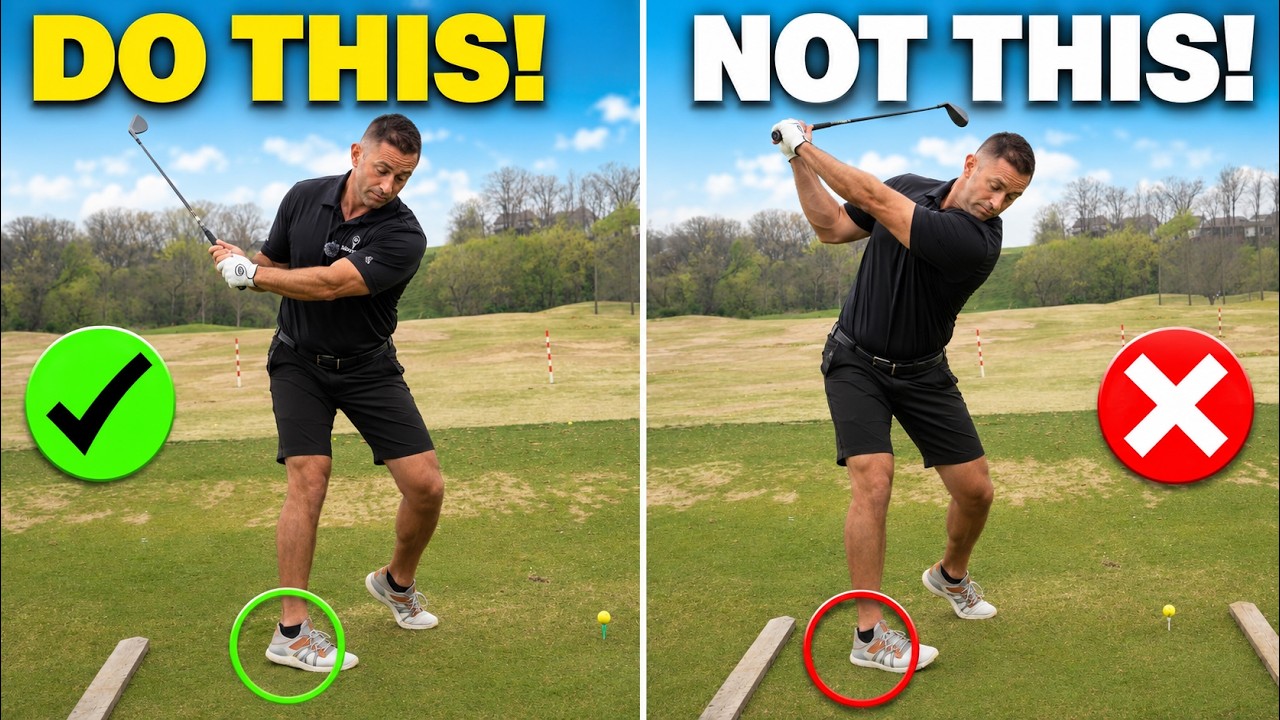
Belt buckle, hands, and club head in perfect alignment at impact makes compressing the ball biomechanically impossible. It is not a technique preference or a style choice. It is a physical reality. And until that alignment changes, the best result available is picking the ball clean, which almost nobody can do consistently enough to build reliable ball striking from.
What Correct Impact Actually Looks Like
Here is the sequence that has to exist at impact for real compression and real ball striking to happen.
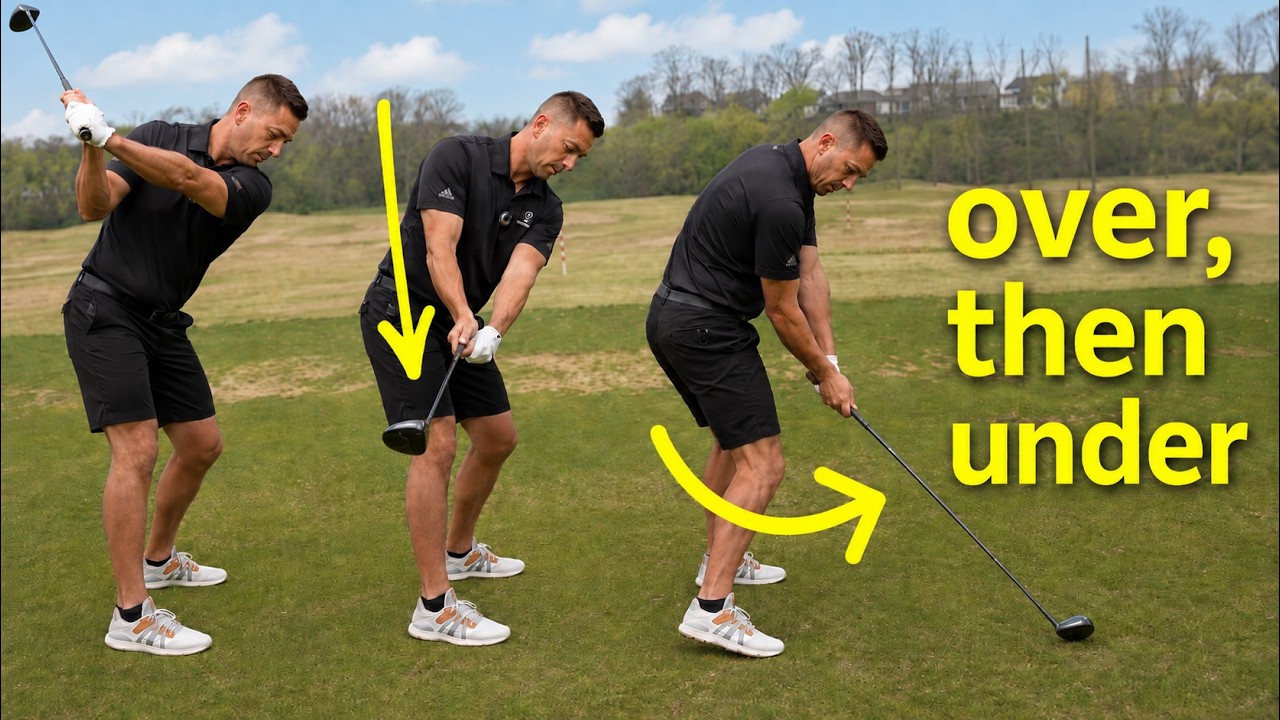
Belt buckle leads. Then hands. Then ball. Then club head.

That sequence is what creates forward shaft lean. Forward shaft lean is what allows the club to hit the ball first and the ground second. Hitting ball first and ground second is compression. Compression is what produces the solid contact, the trajectory, the spin, and the divot after the ball that every golfer is chasing.
When the belt buckle, hands, and club head all line up together at impact, the shaft is vertical or even leaning backward. From that position the only option is to pick the ball. And picking the ball clean on every swing is not a repeatable skill for the vast majority of golfers.
The Door Frame Drill, Training the Feel First
Here is the drill that builds the correct impact position into the body before trying to find it in a real swing.
Stand in a door frame with the left side of the head on the lead side of the frame. The head is not centered in the doorway. The left side of the head is touching or nearly touching the lead side of the frame.
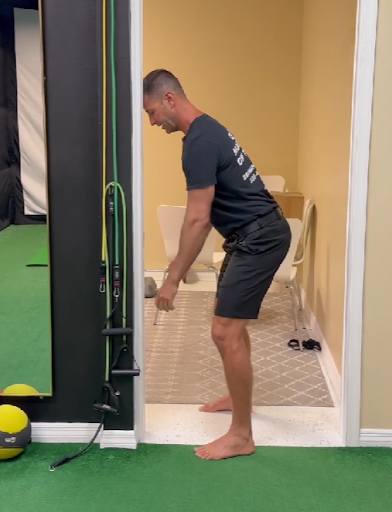
Cross the arms across the chest. Go into the backswing. Then drive the belt buckle as far toward the target as possible while keeping the head behind the door frame.
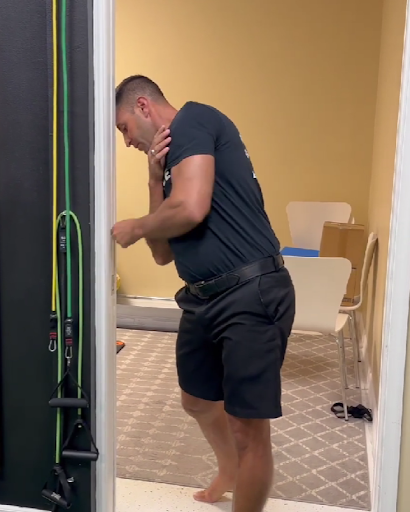
The door frame provides immediate, physical feedback. If the head moves toward the target during the downswing, it hits the frame. The frame prevents the most common impact flaw, the head lurching toward the target as the hips try to clear. The head has to stay behind the ball while the belt buckle gets as far ahead as possible.
Feel what that position is. Belt buckle pointing toward right center field in baseball terms. Head still behind where the ball would be. Muscles stretched on the left side. Everything that was supposed to lead actually leading.
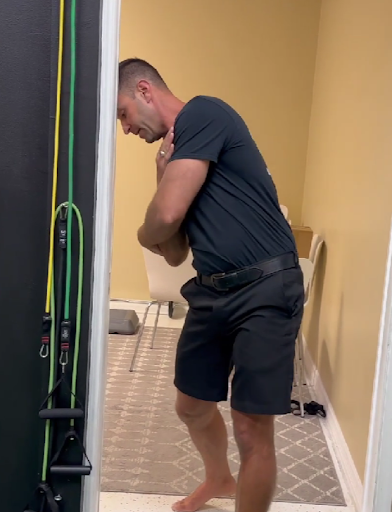
Do this 20 to 30 times in a row without a club. No ball. Just the door frame, the crossed arms, and the deliberate move from address to impact position repeatedly. The brain needs to know what this position feels like before it can reproduce it in half a second during a real swing.
The Club on the Ground Drill
Here is the next step once the door frame drill has built the feel of the correct impact position.
Get into address with a club. Ground the club head so it does not move. Then simply move the belt buckle and the hands forward while keeping the head completely still.
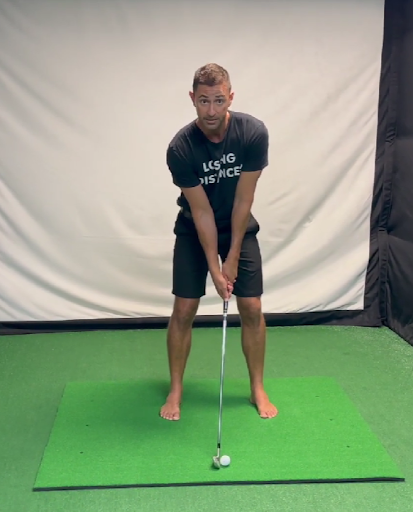
From that forward position, check three things.
Has the weight shifted? The trail heel should be starting to come up as the belt buckle moves forward, confirming weight transfer has happened.
Is the belt buckle ahead? It should be pointing toward right center field, not back at the ball.
Are the hands ahead of the ball? If the club head is still behind the hands and the hands are ahead of the ball, the lag is there.
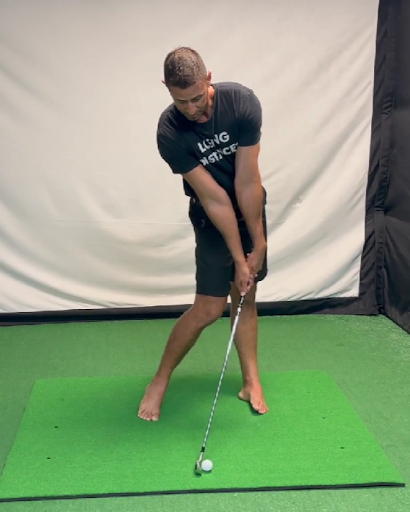
Do this 20 to 30 times from address straight into impact position. Not a full swing. Just address, then move everything forward to the correct impact position, hold, return to address, repeat.
The goal is making this position feel normal. Because it will not feel normal at first. The belt buckle that far ahead with the head that far behind feels exaggerated. It is not. It is correct. The brain just has never experienced it before.
Why Static Has to Come Before Dynamic
Here is the principle that makes this drill work when swing thoughts alone do not.
The golf swing happens in roughly half a second. There is no time to think about getting into the correct impact position while the swing is in progress. Either the body knows the position automatically or it does not find it.
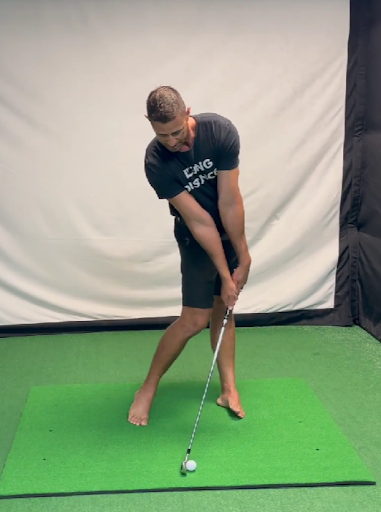
Building the position statically first, through 20 to 30 deliberate reps of just moving from address to impact, gives the brain the physical reference it needs. The muscles learn what stretched feels like on the left side. The hips learn how far forward they need to get. The hands learn what it means to be ahead of the ball.
Once the brain has that reference point from hundreds of static reps, the dynamic swing has somewhere specific to aim. Instead of hoping the impact position shows up during the swing, the brain is trying to recreate a feeling it already knows intimately.
Get a Free Swing Analysis
Want to know whether the belt buckle, hands, and club head are arriving together at impact right now, and exactly what needs to change to create forward shaft lean and real compression?
Set the camera or phone up at two angles. One from the front, face on. One from behind, down the line. Film in slow motion. Swing.
Send both videos to gaindistance.com and Dr. Berman will give a free swing analysis. The first one is on him.
See exactly what the camera shows, not what the brain thinks is happening. The impact position is one of the clearest things visible in slow motion and one of the most revealing pieces of information about why ball striking is inconsistent.
Want a Step-by-Step Blueprint?
If this resonates and the advice out there feels designed for 25-year-old tour pros, there is a simple blueprint built specifically for senior golfers.
It breaks down:
How the aging body changes Which muscles actually produce power How to gain distance without swinging harder How to improve consistency while reducing aches and pains
It is written at a fifth-grade reading level with clear visuals and practical drills that can start immediately.
A FREE digital copy is available at: 👉 gaindistance.com
No gimmicks. Just clarity on how the body should move to play better golf for years to come.
Bringing It All Together
Belt buckle, hands, and club head arriving together at impact makes compression impossible. The sequence has to be belt buckle leading, then hands, then ball, then club head.
The door frame drill builds the feel of that sequence by keeping the head behind the frame while the belt buckle drives as far toward the target as possible. Twenty to thirty reps of crossing the arms and moving to impact position. Then twenty to thirty reps of grounding the club head and moving the belt buckle and hands forward while the head stays still.
Static before dynamic. Build the position the brain can feel before asking the swing to find it in half a second.
At Berman Golf, the focus is biomechanics first. Not cookie cutter swings. The goal is teaching the body how it should move, especially as it ages, so power can be generated safely and repeated under pressure.
The in-house and online coaching programs are built specifically for senior golfers who want more distance and better consistency without beating up their bodies.
For anyone tired of advice designed for tour pros and ready for a blueprint built for their body, help is available.
Because when the belt buckle leads at impact and the hands are ahead of the ball, compression becomes possible and ball striking becomes something that can actually be repeated.
And when ball striking becomes repeatable, the game gets soooooo much easier!
If you enjoyed what you read and want to see it in action, watch the video below where Dr. Berman demonstrates both the door frame drill and the grounded club drill step by step!