Here is the honest diagnosis for every senior golfer who spends hours at the driving range and sees nothing change on the course.
Practice is the problem.
That sounds harsh, but Dr. Berman has seen it many times. One of his students, Frank, 78 years old, came to him frustrated. He spent hours on the range banging balls, then went out to play and nothing improved. He was chunking and topping shots in the fairway.
The first question Dr. Berman asked was simple: what is being practiced on the range that is not showing up on the course?
At Berman Golf, the answer is to practice the body movement first, before a ball is ever in the way.
Why Driving Range Practice Fails
Here is the principle behind it. Practice makes permanent.
If a golfer goes to the range and bangs balls without trying to fix the body mechanics, that is exactly what will happen on the course. The golfer will bang balls, and nothing will be consistent. So the practice has to be perfect, and the focus has to be on the body, not on the ball.
The alternative is to work smarter, not harder.
Set Up the Golf Swing Drill
Here is what is needed: two alignment sticks and a stress ball. Dr. Berman jokes that it is ideal if it is a properly branded stress ball.
Alignment stick number one goes through the belt loop. It should be cheated way out to the right. Alignment stick number two goes across the chest.

Improve Your Golf Hip Rotation
Here is the first step, before the stress ball comes in. Just start rotating.
The goal is to get the bottom stick to rotate farther. Most golfers rotate the upper body, which means the top stick does all the work. Rotate the bottom body instead.

As this happens, the right knee will start straightening farther. There is more rotation now, but it is not efficient yet.
Stop Swaying in Your Backswing
Here is where the stress ball comes in.
Put the stress ball directly under the arch of the right foot. Now, as the golfer rotates into the backswing, keep pressure on the stress ball.
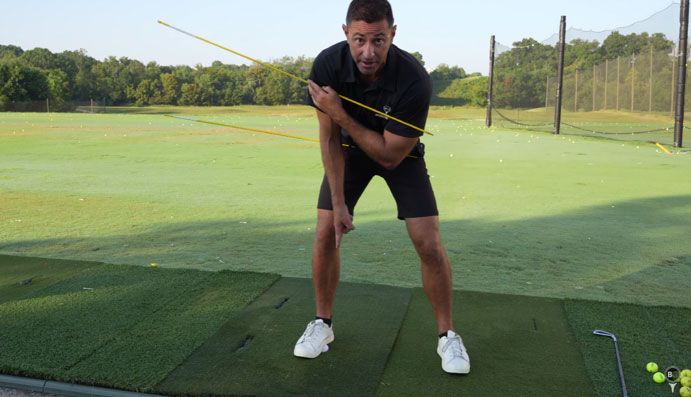
Here is why this matters. If the knee straightens, the foot rolls to the outside. When the foot rolls to the outside, the head sways. Even a half inch of sway in the backswing means a half inch of sway in the downswing. That is an entire inch of sway in less than one second, between address and the ball.
That is too much motion.
Fix Your Right Knee Position
Here is the cue. As the body rotates, think about smashing the stress ball. That keeps a bend in the trail knee, instead of straightening it.
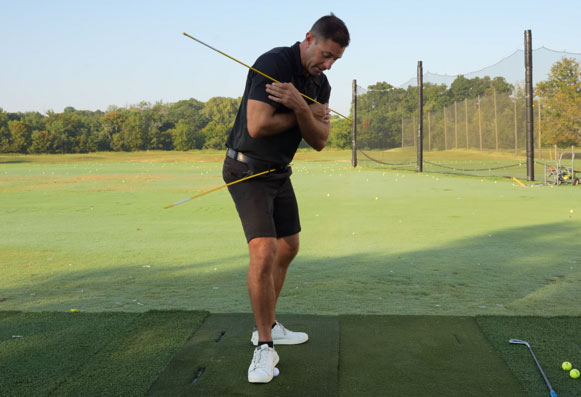
Look at what happens when the knee straightens. The head comes up and slides. That is wasted motion. Unnecessary motion. The more moving parts in a golf swing, the harder it is to make it consistent.
Start Your Downswing With Your Hips
Here is where it all comes together.
As the golfer loads into the trail leg, start rotating with the belt buckle first. When the belt buckle goes first, the top stick will run into the bottom stick.
If the golfer rotates with the upper body first, which is what most golfers normally do, the sticks will never touch.

Here is what to focus on in the backswing. Belt buckle rotates first. Smash the stress ball. Keep the knee bent. Get the left shoulder down. Pull the belly button in so the core is firing.
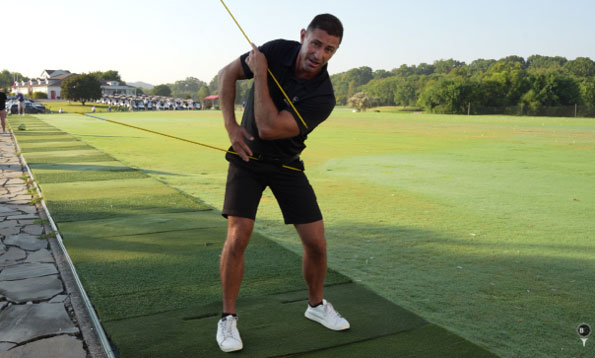
Now bump the hips to the left as the belt buckle rotates. The hips clear, and the top stick can run into the bottom stick. This is rotating the body, instead of folding the arms, hinging the wrists, bending the elbow, and hoping and praying.
Practice This Drill for 5 Minutes
Here is the practice prescription.
See if the golfer can do this 20 times in a row. Rotate. Run into the stick. Rotate. Top stick runs into the bottom stick. That is all that happens for five minutes.
Take a break as needed, because it is real work. But it is re-ingraining how the body is supposed to move. Once it feels good, get rid of the sticks.
Build a More Consistent Iron Swing
Here is the progression. Pick up an iron. Keep the stress ball under the arch of the right foot. Try to replicate the same feeling of rotating versus folding.
Rotate the body, not the arms. Keep pressure on the stress ball. Do not let the knee straighten. There is no power and no consistency there. Keeping the knee bent is how to truly load the trail side, instead of just shifting the weight onto it.
Load, load, load. Then top of the backswing, get through the ball.
Improve Your Swing Without Hitting Balls
Here is the next step. Remove the ball.
Do five swings in a row with no alignment sticks, no stress ball, and no real ball. Top of the backswing, get through. Top of the backswing, get through.

Notice how much work has been done without hitting a single golf ball.
Why Taking the Ball Away Helps
Here is the reason.
As soon as a golf ball is around, the brain shifts from focusing on the process to focusing on the result. Dr. Berman says a golfer does not get better by focusing on results. A golfer gets better by focusing on and obsessing over the process.
Test Your New Golf Swing
Here is the moment of truth. After five minutes on the process, put a ball down.
Load. Get through the ball. The first one tails off and is a little thin. So what went wrong? Dr. Berman did not really load onto the stress ball, which was no longer there.
The fix is to go back to thinking about the stress ball, so the body does not sway and actually loads. Slow down the backswing. Load. Get through.
That one felt much, much better.
Practice Smarter, Not Harder
Here is the lesson.
The goal is not to bang balls and sweat through bucket after bucket. That will not make a golfer better. It will re-ingrain bad habits. Practice makes permanent, so practice perfectly.
The more time spent on body movement without balls getting in the way, the quicker the brain learns how to move.
The Senior Golf Activation Method: Michael’s Story
Here is a real example. Michael, 77 years old, was days away from giving up his country club membership because his body kept giving out on him.
He could play the front nine just fine. By the back nine, his back was killing him. He could not get through the ball. His drives were falling short, and the game was not fun anymore.
According to Dr. Berman, Michael had plenty of flexibility. The problem was that he was not activating the right muscles at the right time. So they focused on getting the core and glutes working, so he could control the transition from the backswing to the downswing.
Michael went on to finish 18 holes at a respectable level of play, and Dr. Berman says he gained 50 more yards on his drive. It was not magic. It was a method called the activation method.
Get a Free Swing Analysis
Want to know whether the right knee is straightening and the head is swaying in the backswing right now?
Set the camera or phone up at two angles. One from the front, face on. One from behind, down the line. Film in slow motion. Swing.
Send both videos to gaindistance.com and Dr. Berman will give a free swing analysis. The first one is on him.
See exactly what the camera shows, not what the brain thinks is happening. The bend in the right knee and the sway of the head in the backswing are two of the clearest things visible in slow motion, and two of the most commonly missed from the inside.
Want a Step-by-Step Blueprint?
If this resonates and the advice out there feels designed for 25-year-old tour pros, there is a simple blueprint built specifically for senior golfers.
It breaks down:
How the aging body changes
Which muscles actually produce power
How to gain distance without swinging harder
How to improve consistency while reducing aches and pains
It is written at a fifth-grade reading level with clear visuals and practical drills that can start immediately.
A FREE digital copy is available at: 👉 gaindistance.com
No gimmicks. Just clarity on how the body should move to play better golf for years to come.
Bringing It All Together
Banging balls does not fix body mechanics. It reinforces whatever is already happening, so practice has to start with the body.
Run an alignment stick through the belt loop and another across the chest. Rotate the bottom body farther. Add a stress ball under the arch of the right foot and smash it to keep the knee bent and stop the sway. Start the rotation with the belt buckle so the top stick runs into the bottom stick. Do it 20 times in a row, for about five minutes.
Then pick up an iron with the stress ball, then drop the ball and do five swings with nothing. Only then put a ball down. Process first, results second.
At Berman Golf, the focus is biomechanics first. Not cookie cutter swings. The goal is teaching the body how it should move, especially as it ages, so power can be generated safely and repeated under pressure.
The in-house and online coaching programs are built specifically for senior golfers who want more distance and better consistency without beating up their bodies.
For anyone tired of advice designed for tour pros and ready for a blueprint built for their body, help is available.
Because when the body rotates, the trail leg loads, and the practice has a purpose, banging balls is not something to waste time on anymore. The improvement shows up on the course.
And when the improvement shows up on the course, the game gets soooooo much easier!
If you enjoyed what you read and want to see it in action, watch the video below where Dr. Berman demonstrates the full five minute drill!