Here is the honest truth about golf that nobody wants to say out loud.
Bad shots are going to happen. Every single round. For every single golfer, from beginners all the way up to tour pros. The goal is not to eliminate bad shots. The goal is to make bad shots less bad, so that when the inevitable miss happens, it is still playable and a bogey is possible instead of a snowman.
At Berman Golf, four boxes get checked before every single shot. Not sometimes. Every time. Because the research inside the simulator shows the same thing consistently. When golfers are checked into all four boxes, bad swings produce manageable misses. When only one or two boxes are checked, the same bad swing turns into a complete disaster.
Here are the four boxes.
Box 1, Grip
When was the last time a PGA pro actually looked at the grip and confirmed whether it is strong, weak, or efficient?
For most golfers, the honest answer is a long time ago, if ever. And the grip is touching the club on every single shot.
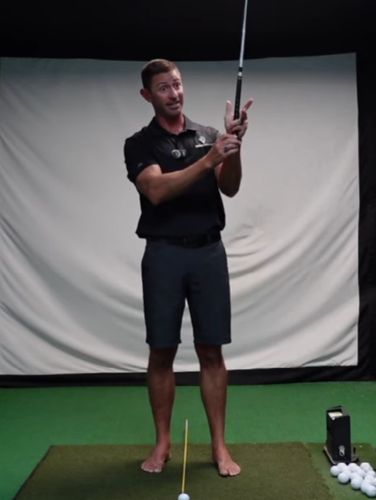
Here is the most common grip mistake seen across new clients. Palming the club. When the club sits in the palm instead of the fingers, the wrist hinge disappears. Without wrist hinge, the release is gone. And without the release, ball striking suffers on every shot regardless of how good the swing mechanics are.
Get the club into the fingers. That is where the fulcrum is. That is where the hinge lives.
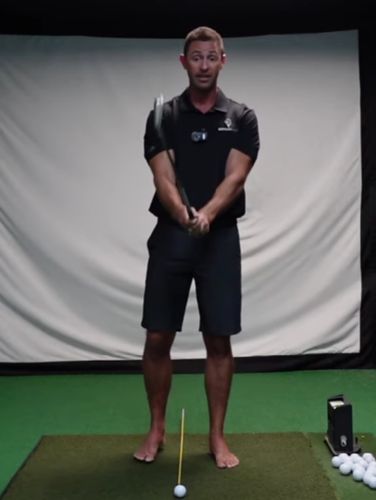
The second grip consideration is grip strength. A stronger grip means the club face closes more naturally through impact without hand manipulation. A weaker grip means the hands have to work overtime to close the face, which is exactly where the big banana slice comes from for most amateur golfers.
If the banana slice is a regular visitor, try exaggerating a stronger grip first and see what changes. It may not be the only cause, but it is one of the quickest boxes to check and adjust.
Box 2, Ball Placement
Take an extra five to ten seconds on this one. It is worth every second.
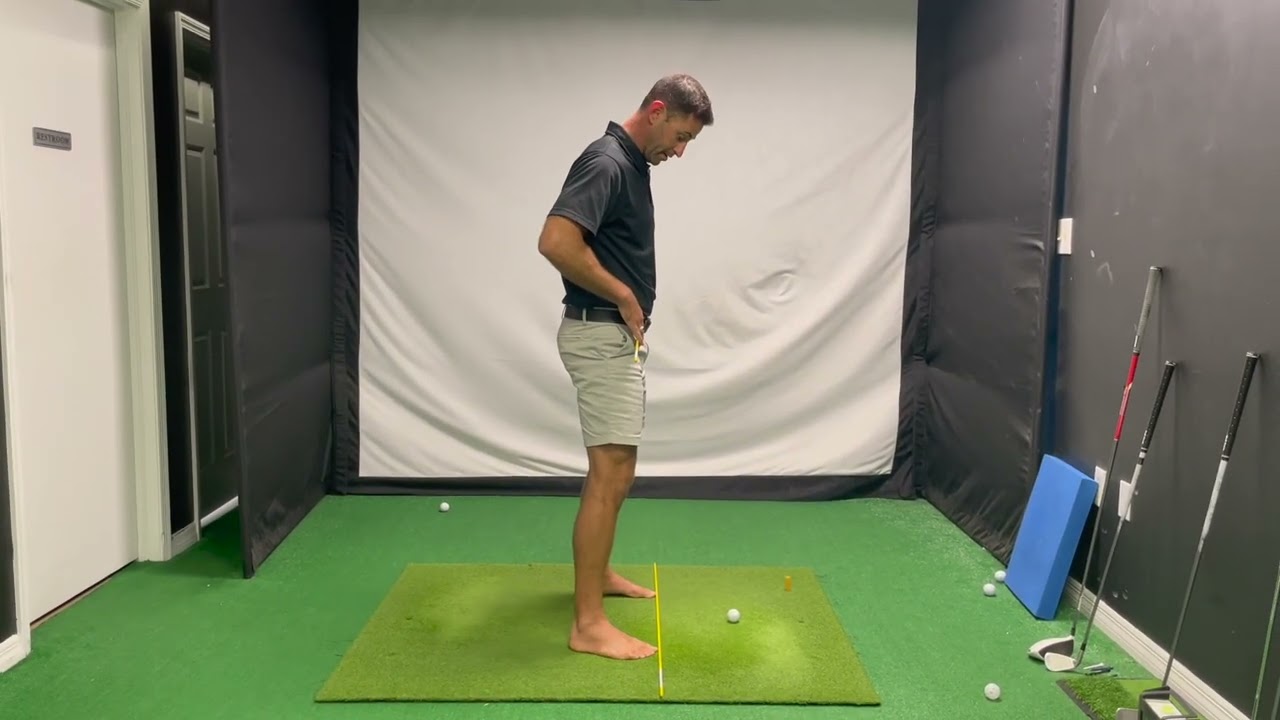
Here is where a correction needs to be made from old school teaching. The traditional advice was center of the stance for a seven iron, ball moving back for shorter clubs and forward for longer ones. That advice is outdated, and here is why.
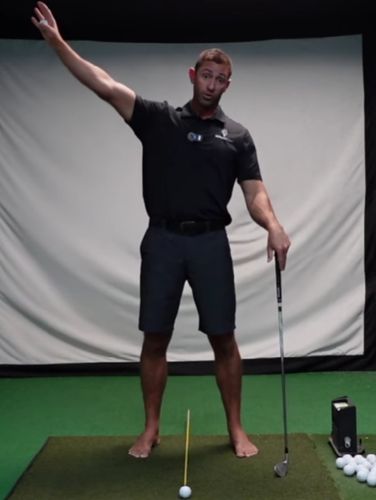
The farther back the ball is in the stance, the steeper the angle of attack has to be to reach it. Steeper angle of attack means more chunking, more thin shots, and more over the top moves trying to compensate.
The new school approach is simpler. Three ball positions, all forward of center.
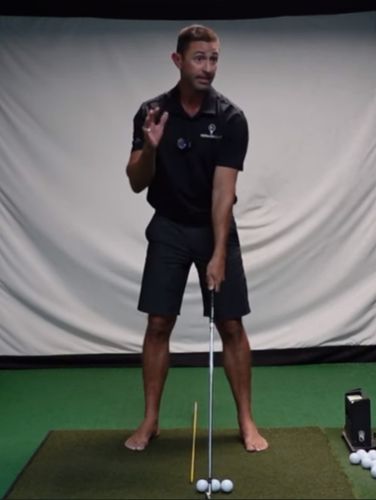
Driver and woods go at the furthest forward position. Mid irons go in the middle forward position. Wedges go at the closest forward position, but still forward of center, not back toward the trail foot.
All three positions allow the body to rotate through the ball instead of having to come down at it steeply. More rotation through impact. Less chunking. Less over the top. Just from moving the ball forward.
Box 3, Alignment
This one takes time, repetition, cameras, and mirrors to get right and keep right. But it is one of the most important boxes on the list.
Feet, hips, and shoulders all need to be pointing in the same direction. All three. Not two out of three. All three aligned together.
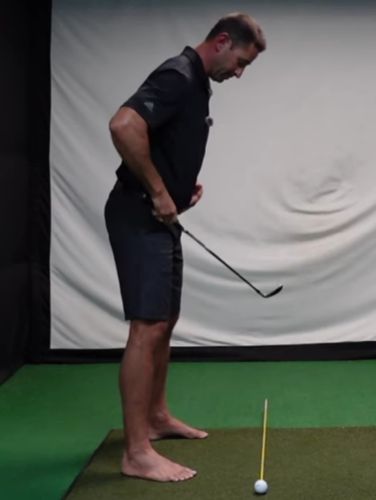
Here is what happens as golfers age and start losing hip mobility or shoulder turn. Compensations creep in. An open stance develops to make it easier to get through the ball. Or a closed stance develops to get a bigger shoulder turn. Both feel like they are helping in the moment. Both create a problem the brain cannot solve.
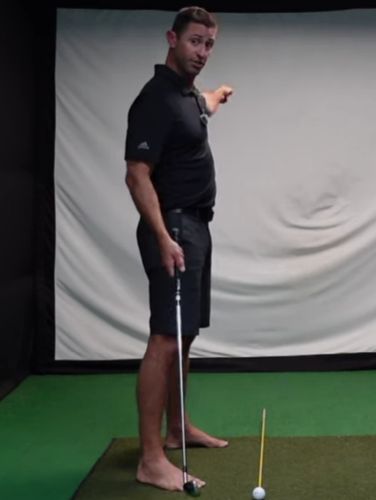
When the feet are pointing one direction and the shoulders are pointing another, the brain knows the target is over there but the body is set up to go somewhere else entirely. The only path available to reconcile that is coming over the top. The brain forces it because it is the only way to get the ball relatively close to where it is supposed to go.
Proper alignment removes that conundrum. When everything points the same direction, the brain can work with the body instead of against it. And when alignment is consistent, swing tendencies become much easier to identify and correct because the variable of misalignment is removed from the equation.
Box 4, Tempo
Here is the most important box of all, and the one that is most consistently not checked.
Ninety percent of golfers coming into the facility have a backswing that is too fast. Not a little too fast. Way too fast.
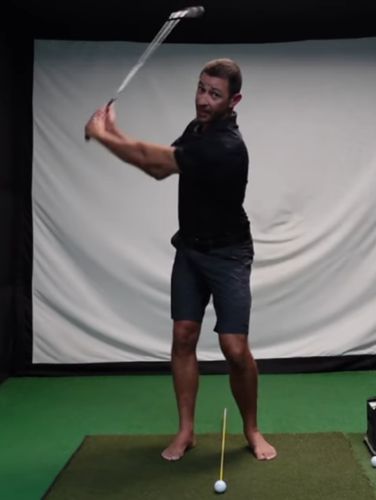
Here is what a fast backswing actually does to the swing sequence. The body never finishes going to the trail side before it tries to reverse and come back to the lead side. The weight never fully loads. The top of the backswing is never truly reached. And then the downswing tries to initiate from a position that is only halfway back, which means the weight is wrong, the sequence is wrong, and getting onto the lead side properly becomes nearly impossible.
The body has to finish going to the right before it can come back to the left. A fast backswing skips that completion. A slow backswing allows it.
Here is the tempo cue that works. Use a three word name said at a steady pace. Dr. Berman uses his own birth certificate name. Michael. Jacob. Berman. The swing starts on Michael, continues through Jacob, and the downswing initiates on Berman. Three distinct beats that give the backswing enough time to complete before the downswing begins.
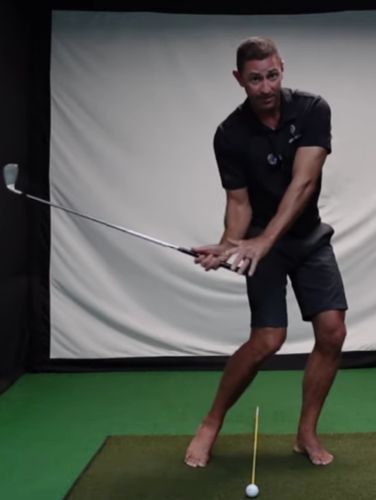
Pick any three syllable name or three beat phrase that feels natural. The point is giving the backswing a rhythm that forces it to be slow enough to complete before reversing.
Why All Four Boxes Matter Together
Here is what the simulator data shows over and over again.
One box checked is usually a disaster. Two boxes checked is better but still produces big misses. Three or four boxes checked and even a poor swing produces a manageable miss, something still in play, something a scramble can recover from.
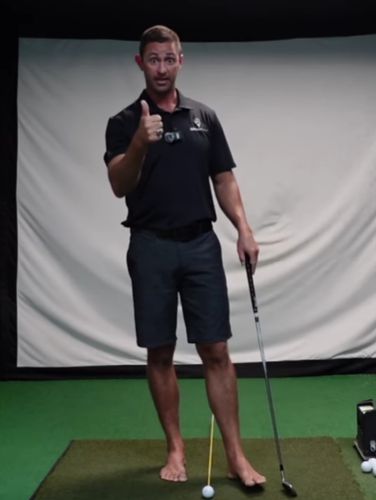
The boxes are not just pre shot routine items. They are the variables that determine how bad the bad shots are going to be. Control the boxes and the floor gets raised. The worst shots become less frequent and less damaging. Pars get made from imperfect contact. Bogeys replace double bogeys.
That is what these four boxes actually do. They do not eliminate bad swings. They make sure that when the bad swing happens, it does not have to ruin the hole.
Get a Free Swing Analysis
Want to know which of the four boxes is consistently not being checked and how much it is costing on the course?
Set the camera or phone up at two angles. One from the front, face on. One from behind, down the line. Film in slow motion. Swing.
Send both videos to gaindistance.com and Dr. Berman will give a free swing analysis. The first one is on him.
See exactly what the camera shows, not what the brain thinks is happening. Then there is clarity on which box, grip, ball placement, alignment, or tempo, is the biggest source of unnecessary bad shots right now.
Want a Step-by-Step Blueprint?
If this resonates and the advice out there feels designed for 25-year-old tour pros, there is a simple blueprint built specifically for senior golfers.
It breaks down:
How the aging body changes Which muscles actually produce power How to gain distance without swinging harder How to improve consistency while reducing aches and pains
It is written at a fifth-grade reading level with clear visuals and practical drills that can start immediately.
A FREE digital copy is available at: 👉 gaindistance.com
No gimmicks. Just clarity on how the body should move to play better golf for years to come.
Bringing It All Together
Four boxes. Grip in the fingers with the right strength for the swing shape. Ball position forward for all clubs to allow rotation through impact. Feet, hips, and shoulders all aligned in the same direction so the brain is not forced into an over the top move to compensate. Tempo slow enough that the backswing actually completes before the downswing starts, using a three beat name or phrase as the rhythm.
Check all four before every shot. Not just before a round. Every single shot. Because when four boxes are checked, even bad swings stay playable.
At Berman Golf, the focus is biomechanics first. Not cookie cutter swings. The goal is teaching the body how it should move, especially as it ages, so power can be generated safely and repeated under pressure.
The in-house and online coaching programs are built specifically for senior golfers who want more distance and better consistency without beating up their bodies.
For anyone tired of advice designed for tour pros and ready for a blueprint built for their body, help is available.
Because when the bad shots are less bad, the scorecard starts looking a lot better even before the swing gets perfect.
And when the bad shots stop wrecking holes, the game gets soooooo much easier!
If you enjoyed what you read and want to see it in action, watch the video below where Dr. Berman and his PGA pro walk through all four boxes in full!