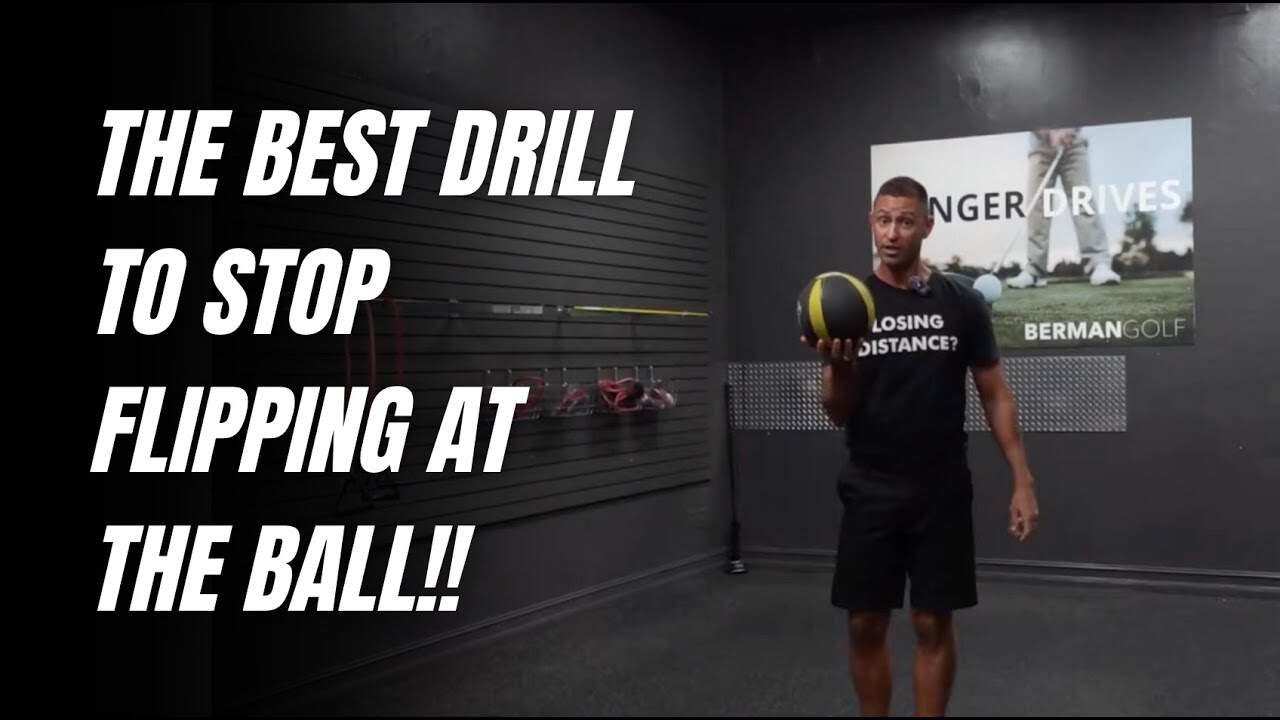
One heavy medicine ball. That is the entire piece of equipment needed for this drill.
So many golfers struggle with flipping at the ball, and most of them have no idea it is even happening until someone points it out. The hands take over right before impact, the club face flips early, and the result is weak contact, lost distance, and inconsistency that feels impossible to pin down.
At Berman Golf, this drill is one of the simplest and most effective ways to fix that, because the equipment itself forces the correction. There is no swing thought required. The weight does the teaching.
Why a Heavy Medicine Ball Works
Here is the logic behind the drill, and it is almost embarrassingly simple once it is explained.
Grab a medicine ball. Six pounds at minimum. Heavier is better, ten pounds, even fifteen pounds if available.

The reason the weight matters is straightforward. A heavy ball cannot be thrown with the arms alone. It is too heavy. The arms simply do not have enough strength to fling something that heavy with any accuracy, so the body is forced to take over and generate the throw instead.
Try throwing it with just the arms. It goes everywhere. There is no way to steer it, no way to control direction, nothing but muscling the thing through brute force. But load the body, turn through the hips and core, and let that rotation throw the ball, and suddenly there is control without much effort at all.
That contrast is the entire point of the drill. Heavy enough that the arms cannot dominate the movement, which leaves the body no choice but to do the work.
The Drill: Load and Unload
Here is how to actually perform it.
Get into an athletic stance holding the medicine ball with both hands. Load into the trail leg, pressing through that right leg, core engaged, shoulders turning back just like the top of a golf backswing.

Then unload. Turn the belt buckle the other direction and let that rotation throw the ball forward.

Load. Unload. Load. Unload. Over and over, feeling the body do the work of loading and releasing the ball instead of the arms.
The Real Test: Can You Hit the Same Spot 10 Times in a Row
Here is how to know whether the body is actually doing the work or whether the arms are sneaking back in.
Pick a target. Imagine a backboard with a square marked on it. The test is simple. Hit that exact same spot ten times in a row.

If the body is generating the throw, the ball lands in the same place every single time, because the body repeats movement patterns far more reliably than the arms do. If nine out of ten throws hit the target and the tenth one veers off somewhere else, that tenth throw was the arms taking over.

Keep the core engaged throughout. Let the arms go soft and loose, almost like noodles just hanging there along for the ride. The core and the legs are doing the loading and unloading. The arms are simply attached.
Ten in a row, same exact spot, every time. That is the homework. Not five. Not eight. Ten, because the ninth one being accurate does not prove the pattern is consistent yet.
The Next Step: Throw a Club
Once the medicine ball test is consistent, here is what comes next.
Take an actual golf club and throw it. Let it go completely. It will not travel more than ten or fifteen yards, and that distance is not the point.

The point is feeling the body send the club in a direction and then literally letting it fly out of the hands. This reveals exactly what the hands have been doing during the real golf swing.
If the club flies way left, the hands have been pulling it around through impact. If it flies way right, the hands have been flipping it open. But if it releases straight out, ten or fifteen yards directly ahead, the body is doing the work of releasing the club instead of the hands steering it.
That feeling, the body releasing the club into a direction rather than the hands manipulating it, is exactly what needs to translate into hitting an actual golf ball. Same release. Same feeling. Just with a ball on the ground instead of letting the whole club fly.
Why This Drill Works So Well
Here is why a drill this simple produces results that more complicated swing thoughts often cannot.
The medicine ball removes the option of using the arms. There is no swing thought to remember, no position to check, no internal monologue running through a checklist mid motion. The weight forces the correct pattern to happen by making the incorrect pattern physically impossible.
That is the same principle behind flipping at the ball during an actual golf swing. Flipping happens when the hands take over because the body never learned to lead the release. This drill teaches the body to lead the release in a context where the hands literally cannot do the job alone.
Once that pattern is built with the medicine ball and confirmed with the club throw, carrying it into the actual golf swing becomes far more natural, because the body already knows what leading the release feels like.
Get a Free Swing Analysis
Want to know whether flipping at the ball is actually happening in the swing right now, before trying to fix it?
Set the camera or phone up at two angles. One from the front, face on. One from behind, down the line. Film in slow motion. Swing.
Send both videos to gaindistance.com and Dr. Berman will give a free swing analysis. The first one is on him.
See exactly what the camera shows, not what the brain thinks is happening. Then there is clarity on whether the body is leading the release or the hands are taking over at the bottom.
Want a Step-by-Step Blueprint?
If this resonates and the advice out there feels designed for 25-year-old tour pros, there is a simple blueprint built specifically for senior golfers.
It breaks down:
How the aging body changes Which muscles actually produce power How to gain distance without swinging harder How to improve consistency while reducing aches and pains
It is written at a fifth-grade reading level with clear visuals and practical drills that can start immediately.
A FREE digital copy is available at: 👉 gaindistance.com
No gimmicks. Just clarity on how the body should move to play better golf for years to come.
Bringing It All Together
One heavy medicine ball. One simple test. Load into the trail leg, unload through the body, and check whether the same exact spot gets hit ten times in a row.
If it does, the body is leading. If it does not, the arms are still sneaking in somewhere. Once the medicine ball test is consistent, move to throwing an actual club to confirm the same body led release, then carry that exact feeling into hitting a real golf ball.
At Berman Golf, the focus is biomechanics first. Not cookie cutter swings. The goal is teaching the body how it should move, especially as it ages, so power can be generated safely and repeated under pressure.
The in-house and online coaching programs are built specifically for senior golfers who want more distance and better consistency without beating up their bodies.
For anyone tired of advice designed for tour pros and ready for a blueprint built for their body, help is available.
Because when the body leads the release instead of the hands flipping at it, contact gets solid and consistent fast.
And when contact is solid and consistent, the game gets soooooo much easier!