If anyone has ever told you, “You lifted your head” and that’s why you chunked it or topped it…
You need to hear this.
Most of the time, lifting your head isn’t the cause.
It’s the result of something else going wrong — and if you fix the real issue, your ball striking improves immediately.
Let’s break down what’s actually happening.
The Real Problem Isn’t Your Head… It’s Your Sway
Here’s the common senior-golfer pattern:
- You straighten the trail knee in the backswing
- Your body sways off the ball (even slightly)
- To get back to the ball, you have to sway the other way
- Your head comes up early as a compensation
- You chunk it or top it
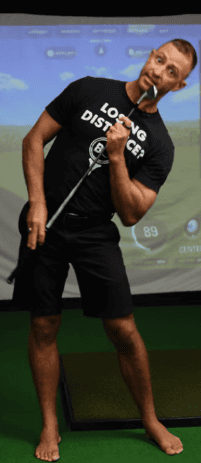
Even if the sway is only a fraction of an inch, it changes where the bottom of your swing arc happens.
Now you’re guessing.
And golf becomes a crapshoot.
So instead of chasing head position, we fix the movement that forces your head to move in the first place.
Fix #1: Keep the Trail Knee Bent and Load the Foot
As you go into the backswing:
- Keep the trail knee bent
- Push pressure through the trail foot into the ground
- Feel your glute and core engage
When you load correctly:
- You maintain spine angle
- You turn instead of sway
- You get true hip turn and shoulder turn
- Your head stays stable naturally
Stability comes from the ground up.
Fix #2: Push Your Hands Away From You (Don’t Wrap)
Most golfers are taught (or they think) the backswing is:
“Take it back and wrap it around you.”
That thought encourages:
- Club wrapping behind the body
- Arms collapsing inward
- A teeter/sway motion off the ball
Instead, use this thought:
Push your hands away from your chest.
Or another simple cue:
Take the clubhead away from the target — not around your body.
This keeps you:
- More on plane
- Wider through the backswing
- More stable through your spine
- Less likely to sway
It’s just a thought — but it changes the motion dramatically.

Fix #3: Slow Down the Backswing
This is the sneaky one.
The faster you rip the club back, the more your body turns off muscles and starts relying on momentum.
When senior golfers rely on momentum, their spine becomes unstable and their head moves more.
But when you slow the backswing down:
- More muscles stay engaged
- The core stays active
- The transition becomes controlled
- The spine stays stable
- The head stays “down” naturally
The goal isn’t “keep your head down.”
The goal is “stay stable enough that your head doesn’t need to move.”
The 3-Part Checklist to Stop Chunking and Topping
If you’re struggling with chunking or topping, focus on these three priorities:
- Load the trail leg (bent trail knee, pressure through the foot)
- Extend hands away (don’t wrap the club behind you)
- Go slower in the backswing (keep muscles engaged for transition)
Do that, and you give yourself a chance to return to the ball consistently — without the head movement that causes chaos.
Want the Full Senior Golfer Blueprint?
If you’re tired of advice designed for 25-year-old tour pros and want something built for senior golfers, I put together a clear step-by-step blueprint to help you move better so you can gain distance and improve consistency.
Download a FREE digital copy at:
It’s written at a fifth-grade reading level with visuals, so you can get clear answers fast and know exactly what to do.
The Biomechanics Advantage
As a Doctor of Physical Therapy with over 15 years of experience working specifically with senior golfers, Dr. Berman specializes in helping aging athletes generate more power and consistency through biomechanics-based movement training.
You don’t need more swing thoughts.
You need better movement.
Stop blaming your head.
Fix the sway, load the leg, stay on plane — and your contact will start cleaning up fast.