Most senior golfers lose distance and consistency at the top of the backswing.
Not because they aren’t trying hard enough.
But because they’re trying to make a bigger backswing instead of a better one.
In fact, one of the most common things I see when seniors come to work with me is a swing that looks big… but produces very little power and almost no consistency.
The good news?
A few simple adjustments to your setup and backswing can dramatically improve both.
The Most Common Backswing Mistake Seniors Make
Many senior golfers believe that a longer backswing equals more distance.
So they try to take the club back as far as possible.
The result usually looks something like this:
- The left elbow bends
- The trail knee straightens
- The head slides away from the target
- The club wraps around the body
This kind of swing might look powerful, but it actually creates a huge problem.
Once your body stops turning, the club keeps moving anyway.
And when that happens, your body has to start compensating.
Why Compensations Destroy Consistency
When your body runs out of room in the backswing, the club still needs to keep moving.
So where does that motion come from?
Usually from:
- Bending the lead elbow
- Over-hinging the wrists
- Straightening the trail knee
- Leaning away from the target
One compensation leads to another.
And another.
And another.
Eventually your swing becomes a series of adjustments and corrections, which is why the ball can go anywhere.
The Real Key to a Powerful Backswing
The quickest way to improve your backswing is not by swinging farther.
It’s by improving your posture at address.
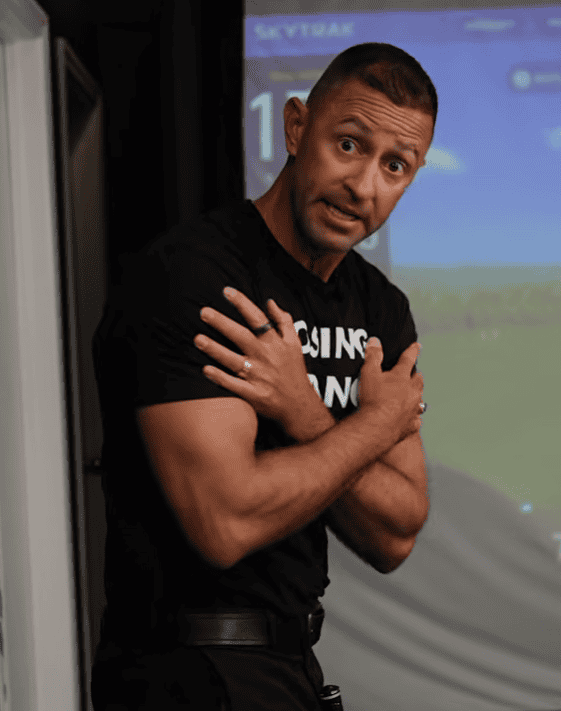
Most seniors set up to the ball by rounding their upper back.
The problem with rounding your back is that it blocks your ability to rotate your spine.
Specifically, it limits the rotation of your thoracic spine — the section between your shoulder blades.
And when that part of your spine can’t rotate properly, your backswing gets stuck almost immediately.
The Simple Posture Fix
Instead of rounding down toward the ball, focus on two simple movements:
First, pull your belly button in tight.
Then lift your chest slightly.
That small adjustment immediately frees up your spine so your shoulders can rotate more naturally.
You might only move your chest a quarter inch.
But that small change can double or even triple your true shoulder turn.
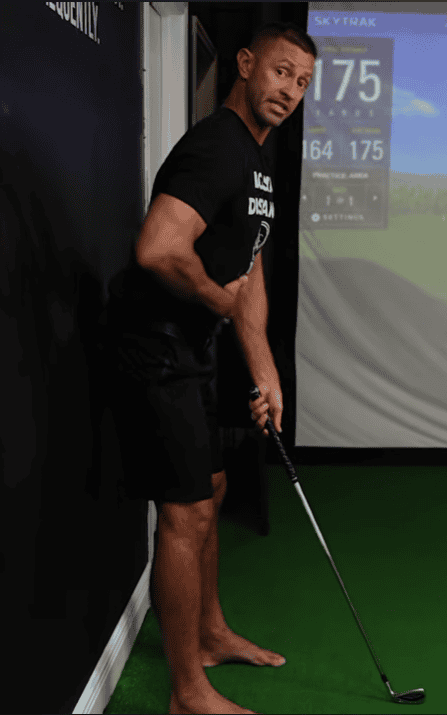
The Proper Backswing Position
Once your posture is correct, the next step is improving how the club moves early in the backswing.
Instead of swinging the club way behind you, think about stopping when the shaft is roughly parallel to the ground.
At that point, four key things should line up:
- Your belt buckle
- Your hands
- The butt end of the club
- The club head
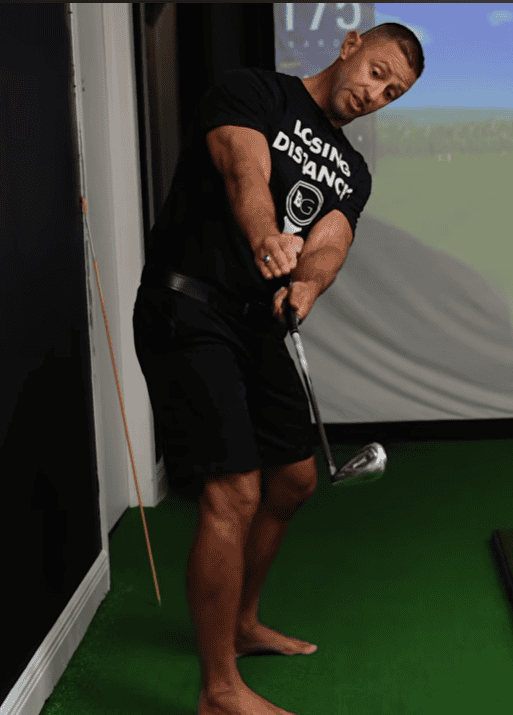
When everything stays aligned like this, you’re turning your body, not just moving the club with your hands.
That means your power is coming from the core, glutes, and legs instead of your wrists and arms.
Load Power Into the Trail Leg
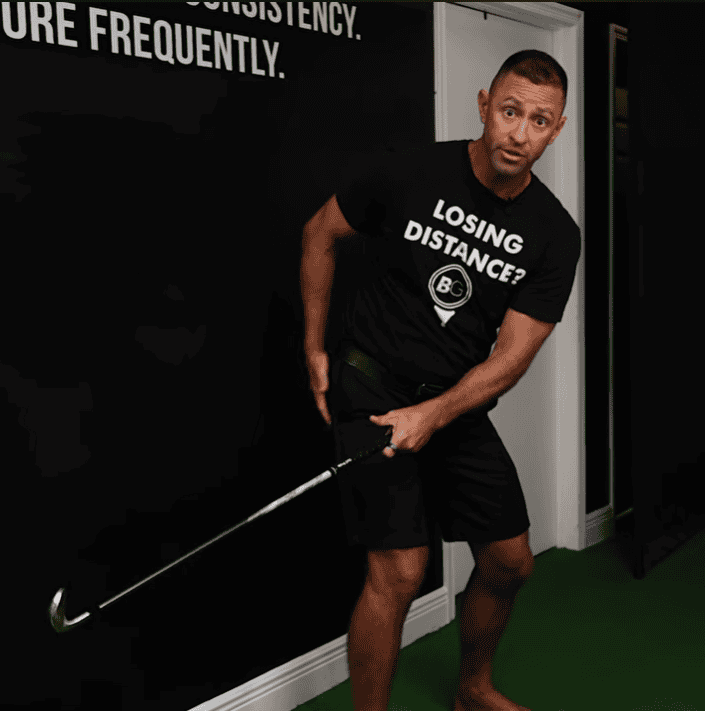
Another key part of a powerful backswing is maintaining bend in the trail knee.
Many golfers straighten this knee as the club goes back.
When that happens:
- Your weight shifts into the heel
- Your hip stops loading
- You lose the ability to generate power
Instead, keep the trail knee slightly bent so your right glute and right leg can load like a spring.
This allows you to build power during the backswing that can be released during the downswing.
Work Smarter, Not Harder
Most golfers try to gain distance by swinging harder.
But that rarely works.
The key is improving how your body moves so the swing becomes more efficient.
When your posture is correct and your backswing stays connected:
- Your shoulders can rotate freely
- Your body can load properly
- Your swing becomes easier to repeat
And that’s when both distance and consistency improve.
Bringing It All Together
If you want to gain distance as a senior golfer, don’t focus on making a bigger swing.
Focus on building a better foundation.
Start with good posture.
Free up your spine so your shoulders can rotate.
Keep your trail knee bent so you can load power into the back leg.
And allow your body — not your hands — to control the swing.
At Berman Golf, we focus on biomechanics first.
We don’t teach cookie-cutter swings designed for 25-year-old tour professionals. Instead, we teach golfers how their bodies should move so they can generate power safely and repeat it consistently.
Because when your body moves correctly, the golf swing becomes much easier.
And when the swing becomes easier, distance becomes a natural byproduct.