Eight sequential steps. One simple truth behind all of them.
You cannot have a good downswing without a really good backswing. That is not a motivational line. It is the entire premise of this drill. Get the backswing right, in the correct order, and the downswing becomes the easy part. Skip a step or do them out of order, and no amount of downswing thoughts will fix what already went wrong on the way back.
At Berman Golf, this is the framework we use to rebuild a swing from the ground up. Not flashy. Not complicated. Just the right steps in the right order.
Step 1: Get Into the Right Posture
Here is the number one mistake most golfers make before the club ever moves.
They reach for the ball by rounding the back. The spine curves forward, the shoulders hunch, and the posture is already wrong before the swing has even started.
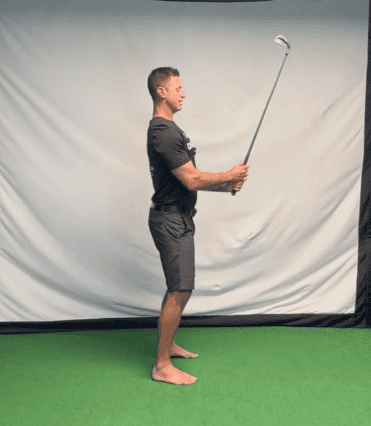
Here is the fix. Stand tall. Pull the belly button in. Unlock the knees so there is a slight bend. Shut the door with the butt, meaning the hips push back slightly to set the spine angle without rounding the back.
That position, tall spine and hips back, is the spine angle that needs to be maintained for the rest of the swing. Lose it here and there is nothing to maintain later.
Step 2: Get the Right Muscles Firing at Address
Posture alone is not enough. The muscles have to be switched on before the backswing starts.
Pull the belly button in even harder than before. That is the core engaging. Then start increasing pressure through the trail foot.
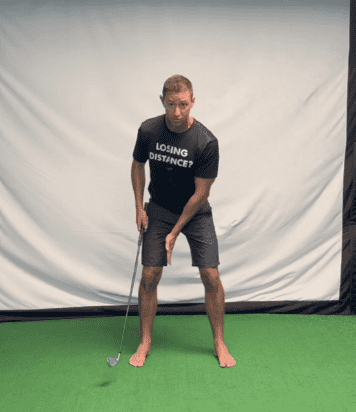
Here is the catch. As pressure increases through the trail foot, the knee cannot be allowed to buckle inward. Press through the foot while keeping the knee stable. That combination is what gets the trail glute firing.
Do this barefoot. The muscles in the foot need to feel the ground directly so they can wake up and contribute to the chain.
Step 3: Initiate the Backswing With the Belt Buckle
Here is the most important step in the entire sequence.
Initiate the backswing with the belt buckle, not the hands.
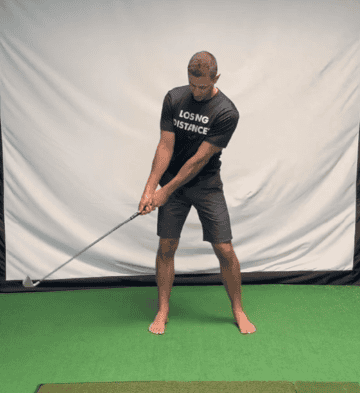
The hands and the belt buckle should stay directly in front of each other as the backswing begins. Not hands moving first and the belt buckle catching up later. Together, from the very first inch of motion.
This single step determines almost everything that happens later in the swing, and there is a biomechanical reason why, covered in detail below.
Step 4: Take the Knuckles Directly Away From the Target
Here is where most golfers go wrong next.
The instinct is to raise the arms up early in the backswing. The problem with that is simple. If the arms get raised up, they then have to drop back down later, and now there is a timing equation that has to work out perfectly on every single swing. It almost never does.
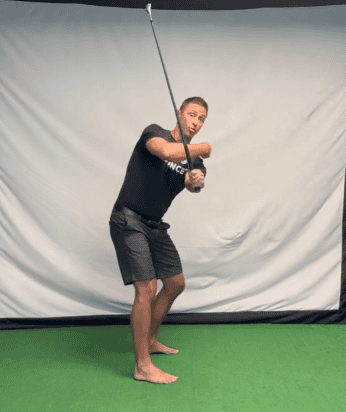
Instead, take the lead hand knuckles directly away from the target. Not up. Not around. Directly away. That single adjustment increases true shoulder turn while keeping the spine angle intact, because the body is turning within the same cylinder instead of raising up out of it.
Step 5: Put It All Together in the Backswing
Now combine everything from the first four steps into one motion.
Address position. Posture set, chest up. Core engaged, belly button pulled in. Pressure increasing through the trail foot. Find a spot on the ground to focus on so the head does not move during the swing.
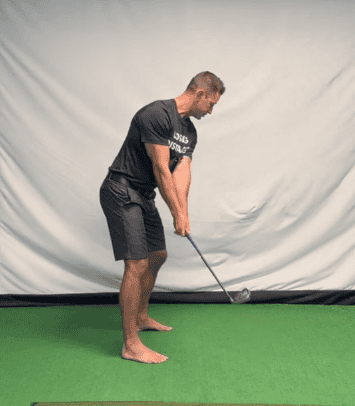
From there, the belt buckle starts moving. The lead knuckles push away from the target. The pressure through the trail leg keeps increasing. All of it happening together is what allows the body to turn within the cylinder instead of collapsing or rising out of it.
Step 6: The Training Secret, Exaggerate the Squat
Here is a training cue that makes loading the trail leg click immediately.
As the backswing happens, exaggerate a squatting motion into the trail side.
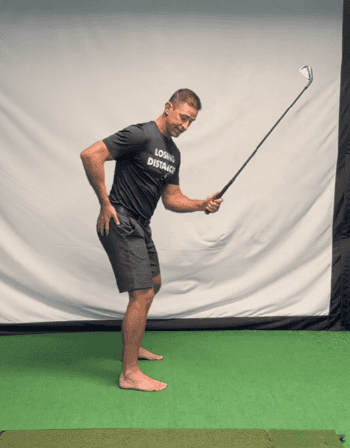
This is purely a training exercise, not something to take onto the course in this exaggerated form. The purpose is to feel what real loading feels like in the trail leg. If the trail leg straightens during the backswing, it cannot be loaded. If it bends, it can. Exaggerating the squat builds that feeling fast.
Once the backswing is mastered through these six steps, there is finally a real chance at initiating the downswing with the body instead of the hands and arms.
Step 7: Initiate the Downswing With the Belt Buckle Going the Other Way
At the top of the backswing, everything should be loaded. The knuckles are away from the target. A spot on the ground has been found so there was no sway. Everything is firing.
The first move of the downswing is the belt buckle reversing direction.
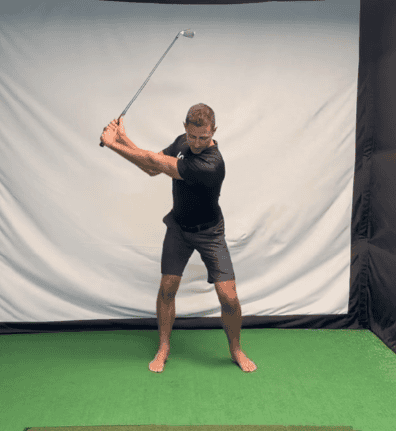
Not pulling the hands down. Not flipping at the ball. The belt buckle starts going in the opposite direction first, and the hands follow from there. That is the entire initiation of the downswing.
Step 8: Finish With the Belt Buckle Pointing at the Target
Here is the simplest step of all, and also one of the most commonly missed.
Finish the swing with the belt buckle pointing directly at the target. Not at right center field, which is where so many golfers stop short.
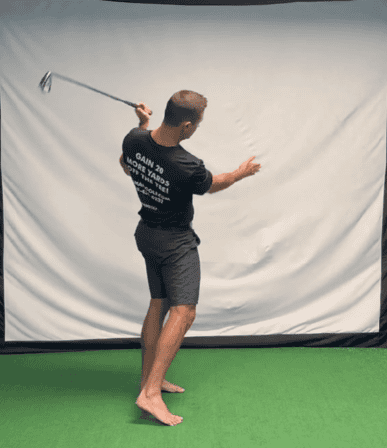
Get all the way through the swing so the belt buckle finishes facing the target. That completion is what confirms the body led the swing all the way through instead of stalling out partway and leaving the arms to finish the job.
Why the Order Matters More Than Any Single Step
Here is the biomechanical reason the sequence has to happen in this order, starting with step three.
Whatever moves first, the brain registers as the primary mover of the entire swing.
If the hands initiate the backswing, the brain locks in that information immediately. Hands are the primary mover. And no matter how hard the intention is to initiate the downswing with the body, the brain already knows the hands are in charge. It will not allow the body to take over. The result is flipping at the ball or pulling the hands down, because the brain is just following the instructions it was given at the start of the backswing.
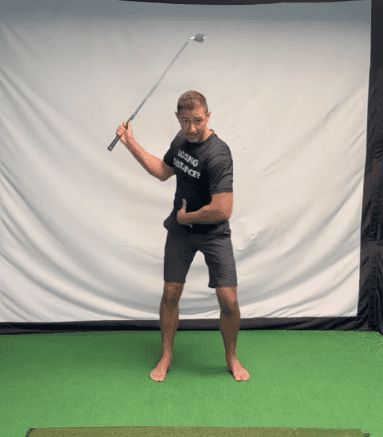
When the belt buckle initiates the backswing instead, the brain receives a different message. The body is the primary mover. The body takes the club back, and the body brings it through on the way down. That is the entire reason step three carries more weight than any other step in this sequence.
Get the steps in order, as close to perfect as possible, before even thinking about the downswing. The downswing is not a separate skill to practice on its own. It is simply what happens when the backswing was built correctly in the first place.
Get a Free Swing Analysis
Want to know exactly what your backswing sequence is doing right now, before trying to fix it?
Set the camera or phone up at two angles. One from the front, face on. One from behind, down the line. Film in slow motion. Swing.
Send both videos to gaindistance.com and Dr. Berman will give a free swing analysis. The first one is on him.
See exactly what the camera shows, not what the brain thinks is happening. Then there is clarity on exactly which of the eight steps needs the most work.
Want a Step-by-Step Blueprint?
If this resonates and the advice out there feels designed for 25-year-old tour pros, there is a simple blueprint built specifically for senior golfers.
It breaks down:
How the aging body changes Which muscles actually produce power How to gain distance without swinging harder How to improve consistency while reducing aches and pains
It is written at a fifth-grade reading level with clear visuals and practical drills that can start immediately.
A FREE digital copy is available at: 👉 gaindistance.com
No gimmicks. Just clarity on how the body should move to play better golf for years to come.
Bringing It All Together
Eight steps. One order. Posture, then engaged muscles, then belt buckle leading the backswing, then knuckles away from the target, then the full combination, then the exaggerated squat for training, then the belt buckle reversing to start the downswing, then the belt buckle finishing at the target.
Skip none of them. Do them out of order and the downswing has nothing solid to work from.
At Berman Golf, the focus is biomechanics first. Not cookie cutter swings. The goal is teaching the body how it should move, especially as it ages, so power can be generated safely and repeated under pressure.
The in-house and online coaching programs are built specifically for senior golfers who want more distance and better consistency without beating up their bodies.
For anyone tired of advice designed for tour pros and ready for a blueprint built for their body, help is available.
Because when the belt buckle leads the backswing and finishes at the target, the downswing finally has something good to work with.
And when the downswing works the way it should, the game gets soooooo much easier!