

Take a look at a slow-motion swing from a 77-year-old golfer right before impact.
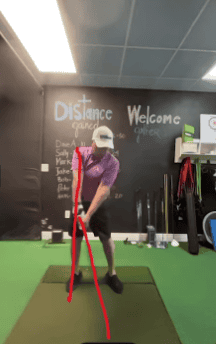
His right arm is completely straight, the back of his wrist is pointing toward the target and the club is trailing far behind his hands.
That’s lag.
And that position is one of the biggest reasons he can generate impressive distance—even at 77 years old.
The truth is, lag isn’t about swinging harder.
It’s about how the body moves during the downswing.
Unfortunately, most golfers—especially senior golfers—don’t actually look the way they think they do at impact.
They think their hands are forward.
But when we look at slow-motion video, 99% of senior golfers actually look very different.
The Real Reason Most Golfers Flip at Impact
Most golfers believe they look like this at impact:
- Hands forward
- Club trailing behind
- Strong shaft lean
But in reality, most swings look more like this:
- Hands even with the club head
- Wrists releasing early
- The club flipping through the ball
Then the swing simply finishes.
This happens because of the first move from the top of the backswing.
If your:
- Body
- Arms
- Hands
- Club
all start the downswing together, you lose the separation needed to create lag.
Everything arrives at the ball at the same time.
When that happens:
- The shaft lines up with the arms
- The club releases early
- Compression disappears
Without separation, lag cannot exist.
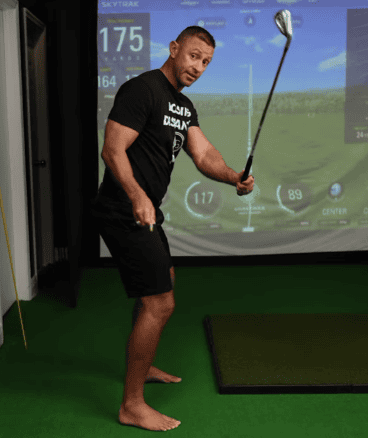
Why the Downswing Must Start With Your Hips
The key to creating lag is learning how to dissociate the lower body from the upper body.
In simple terms:
- Your hips start moving first
- Your upper body follows
- The club head trails behind
This motion begins with your belt buckle.
When the downswing starts with your belt buckle moving toward the target, something powerful happens:
- Your hips move ahead of your shoulders
- Your hands move ahead of the club head
- Lag is created naturally
But if your belt buckle stays pointed at the ball during the downswing, you physically cannot get your hands forward.
You would have to manipulate the club in the last split second.
And that’s extremely difficult for amateur golfers—especially seniors.
You’re not:
- 20 years old
- On the PGA Tour
- Able to rely on extreme flexibility
So instead of swinging harder, we work smarter.
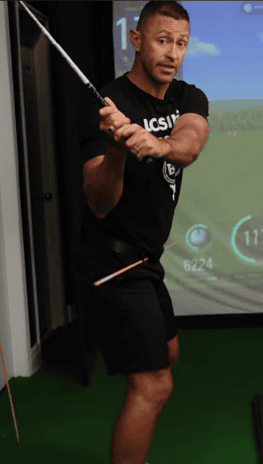
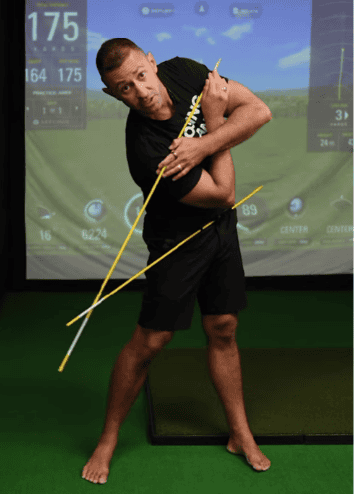
The Alignment Stick Drill That Shows You Lag
A simple way to visualize this is by using two alignment sticks.
If your entire body starts the downswing together, the sticks will remain aligned.
At impact:
- Everything arrives at the same time
- There is no separation
- Lag disappears
But when the downswing starts with your hips, something different happens.
Your hips move ahead of your shoulders.
That creates visible separation between the two sticks.
This means your hands are now in front of the club head.
When that happens:
- You compress the golf ball
- You strike down on the ball
- You generate more distance
Without that separation, lag is physically impossible.
Why Creating Lag Alone Won’t Fix Ball Striking
There’s something important golfers need to understand.
Creating lag and improving ball striking should happen together.
But they don’t always happen automatically.
You can create lag and still struggle with contact if another part of the swing is moving incorrectly.
One of the biggest culprits?
Head movement.
The Head Position That Controls Your Ball Striking
Watch slow-motion videos of professional golfers.
They swing incredibly fast.
But their head barely moves.
The head acts as an anchor point for the entire swing.
When the head stays stable:
- Your spine angle stays consistent
- Your low point becomes predictable
- Ball striking improves dramatically
But when the head sways during the swing:
- The low point shifts
- Contact becomes inconsistent
- Even good lag won’t produce solid strikes
So if we want to create lag and improve ball striking, we must keep the head stable.
The Simple At-Home Drill That Teaches Lag
One of the best ways to train this movement is inside your home—not at the driving range.
This drill exaggerates the motion so your brain can understand what correct lag feels like.
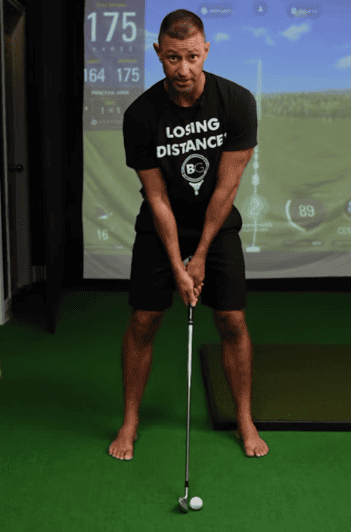
Step 1: Set Up
Start in your normal address position with a golf ball in front of you.
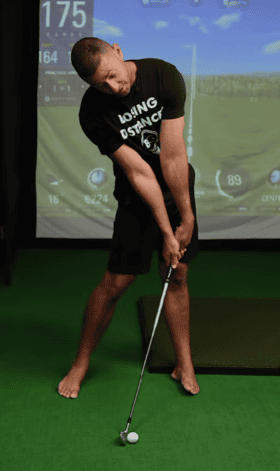
Step 2: Shift the Lower Body
From that position:
- Push your belt buckle toward the target
- Drive through your trail leg
- Shift your weight onto your lead leg
- Keep your eyes looking at the back of the golf ball
This should feel like a huge exaggeration.
You should feel:
- Your right glute firing
- Your core activating
- Your lead arm staying straight
- Your wrists remaining hinged
Step 3: Drag the Ball Forward
Now perform the key part of the drill.
Using your lead hand, drag the golf ball forward.
This helps your brain eliminate the early release that causes the flip.
Repeat the motion slowly:
- Push the hips forward
- Keep the head steady
- Drag the ball forward
Over and over again.
This builds the feeling of hands leading the club head.
Why This Drill Should Be Done at Home
This drill is meant to train movement, not hitting golf shots.
That’s why it should be practiced inside your house.
Do it:
- In your living room
- In the air conditioning
- Without hitting a golf ball
Right now, we’re simply training the brain.
By exaggerating the movement, your brain begins to understand what correct sequencing feels like.
Later, when you go to the driving range and swing at full speed, your body has a chance to recreate a small percentage of that motion.
And that’s all you need.
Why This Is Especially Important for Senior Golfers
Most golf instruction assumes golfers can simply move faster or harder.
But the aging body moves differently.
As we get older:
- Hip mobility decreases
- Core activation weakens
- Reaction time slows down
Trying to manipulate the club at the last second simply doesn’t work anymore.
Instead, the swing must rely on proper sequencing.
When the hips lead the downswing:
- The hands move forward naturally
- Lag appears automatically
- Power increases without extra effort
And that’s how senior golfers can still gain distance.
Want a Step-by-Step Blueprint for Senior Golfers?
If you’re frustrated with golf advice designed for 25-year-old tour pros, I created something specifically for you.
This simple blueprint explains:
- How the aging body changes
- Which muscles actually produce power
- How to gain distance without swinging harder
- How to improve consistency without pain
The guide is written at a fifth-grade reading level and filled with clear visuals.
You can download a FREE digital copy here:
No gimmicks. Just a clear plan to help senior golfers move better and play better.
Train the Movement First—Then Hit Balls
One of the biggest mistakes golfers make is trying to fix their swing while hitting balls.
But hitting balls is about performance, not learning.
Instead, follow this sequence:
- Train the movement at home
- Teach your brain the correct feeling
- Then take it to the driving range
Separating practice from performance speeds up improvement dramatically.
Bringing It All Together
If you want to create real lag in your golf swing, the solution isn’t swinging harder or trying to force your hands forward at impact.
It starts with how the downswing begins.
When the belt buckle moves toward the target first, the hips begin to lead the motion. When the hips lead the motion, the hands naturally move ahead of the club head. And when the hands move ahead of the club head, lag begins to appear.
Add a stable head position and eliminate the early flip, and you’ll start compressing the golf ball the way great ball strikers do.
At Berman Golf, we focus on biomechanics first. We don’t teach cookie-cutter swings designed for 25-year-old tour professionals. We teach golfers how their bodies should move—especially as they age—so they can generate power safely and repeat it under pressure.
Because when your body moves correctly, the golf swing becomes much easier.
And when the swing becomes easier, distance and consistency become a natural byproduct.

Dr. Jake Berman