Here’s a question most senior golfers can’t honestly answer.
Can you actually feel your right glute firing at the top of your backswing?
Not feel it in a vague, general way. Actually feel it—working, loaded, on fire—the way it needs to be to generate real power through the downswing?
If the answer is no—or if you’re not sure—that’s the whole problem. You can’t activate a muscle you can’t feel. And you can’t build power from a muscle that isn’t firing.
At Berman Golf, this is one of the most overlooked gaps in senior golfer training. Not a swing flaw. A connection problem. The brain and the right glute aren’t talking to each other clearly enough during the backswing—and this drill is the most direct way to fix that.
Why the Right Glute Goes Quiet
Before we get into the drill, here’s what’s happening.
The right glute is the single biggest power muscle in the golf swing. When it’s loaded at the top of the backswing and fires on the way down, it drives everything—hip rotation, core engagement, club head speed, distance.
But for most senior golfers, it’s not firing. And the reason almost always comes down to one of three things.
The core isn’t engaged. The trail knee is straightening during the backswing. Or the weight is rolling to the wrong part of the foot—onto the heel or the toe instead of staying on the middle arch.
When any one of those three things is off, the glute doesn’t get the signal to activate. It just sits there while the arms, the back, and the shoulders try to do the work it was supposed to be doing.
This drill fixes all three at once—and it makes the glute fire so hard you can’t ignore it.
The Setup: Resistance Band Against the Wall
You need a thick resistance band attached to the wall at roughly hip height. Walk out until the band has real resistance—enough that you feel it working to pull you backward.
Stand tall. No leaning into the band. Get into your address position—soft knees, hips back, belly button pulled in.
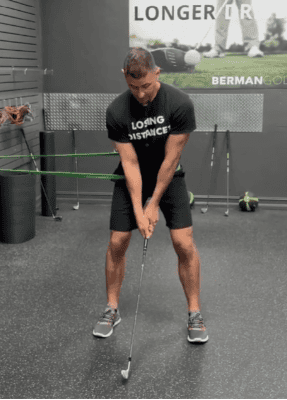
Here’s what you should feel immediately just from standing in address position with the band pulling.
The right leg working. Already. Before you’ve done anything.
If you don’t feel it, one of three things is off. Core isn’t engaged. Trail knee isn’t bent enough. Or the weight isn’t on the middle of the foot—it’s on the heel or the toe somewhere it shouldn’t be.
Those are your checkpoints before you progress to any of the three levels.
Level One: Dance the Lead Foot
From address position with the band pulling, push through the trail foot so hard that you can lift the lead foot and tap it—dance it—without your head moving.
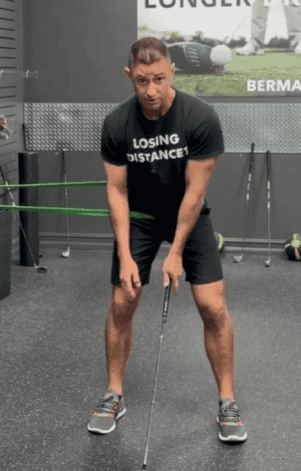
That’s it. That’s level one.
It sounds simple. It isn’t. Because to keep the head still while dancing the lead foot, the trail foot has to be pressing hard through the arch. The trail knee has to stay bent. The core has to be holding the spine stable against the band’s pull.
When all three are happening—and they all have to be happening or the head moves—the right glute fires. Hard. Immediately.
Feel it? That’s the feeling you’ve been trying to reproduce in your backswing for years. It’s been there the whole time. The drill just makes it loud enough to recognize.
Level Two: The Dosey-Do
From the same address position, start moving back and forward—a small dosey-do pattern. Back, forward, back, forward. Use a club for balance if you need it to keep the head from swaying.
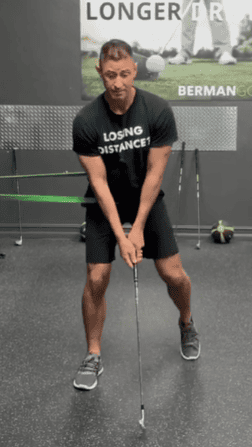
The band is pulling constantly. The foot is working constantly. The glute is firing constantly.
This level adds a dynamic element that starts to build not just activation—but endurance. And endurance matters. A round of golf takes four hours. If the glutes give out on the back nine, the whole swing deteriorates. The power goes. The consistency goes. The body starts compensating.
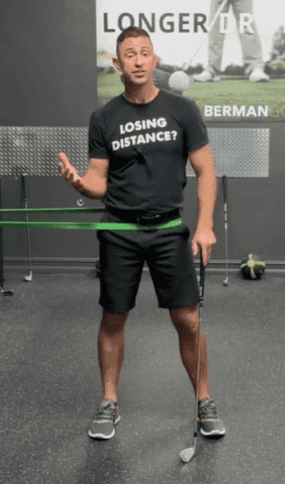
Do this barefoot or with minimal supportive shoes if possible. The muscles in the arch of the foot are part of the activation chain that leads to the glute. When they can actually feel the ground, they contribute. When they’re buried in thick-soled shoes, they go quiet—and the glute is harder to activate as a result.
Level Three: Tap and Hold
Here’s the hardest level.
From address, push through the trail foot hard enough to move the lead foot back—and then barely touch it to the ground. Just a tap. Just barely.
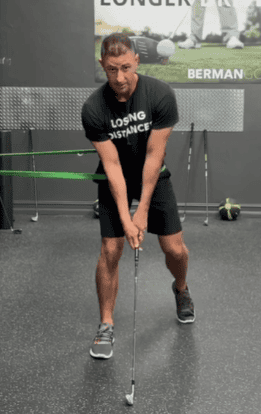
Almost all of the weight is now on the trail leg. The band is still pulling backward. The trail foot is the only thing keeping you from falling—and it has to drive through the arch to do that.
If the right glute isn’t screaming at this point, something in the chain is broken. Go back to the checkpoints. Core engaged? Trail knee bent? Weight on the middle arch? When all three are right and the band is pulling, level three makes the glute fire harder than almost anything else we’ve found.
Progress Into the Backswing
Once the glute is lit up from level one, two, or three, here’s how to connect it directly to the swing.
While maintaining everything—band pulling, lead foot dancing, trail knee bent, foot pressure on the arch—go into the backswing.
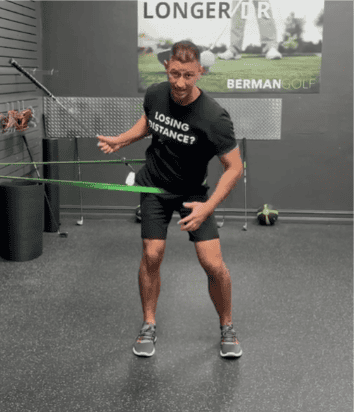
Belt buckle turning. Trail knee staying flexed. Head still anchored on a spot. Don’t let the right knee straighten as the rotation happens. Keep dancing the lead foot at the top if you can.
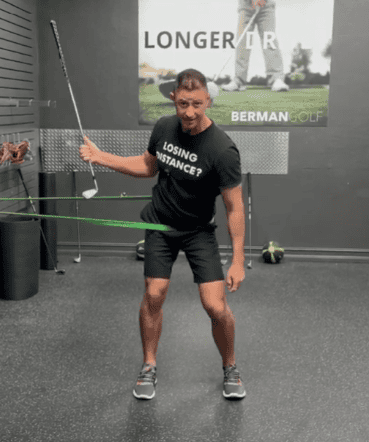
At the top of the backswing with the band still pulling and the foot still working—that’s the feeling. That’s what the loaded backswing should feel like. That’s the glute activation that has been missing from your swing.
The band forces it. The foot pressure creates it. The bent trail knee allows it. Now the brain has a clear, undeniable reference point for what it’s supposed to feel like.
Build to Three Minutes
Here’s the goal: three uninterrupted minutes of this drill.
Set a timer. See how long you can maintain the position, the foot pressure, and the glute activation before the fire goes out.
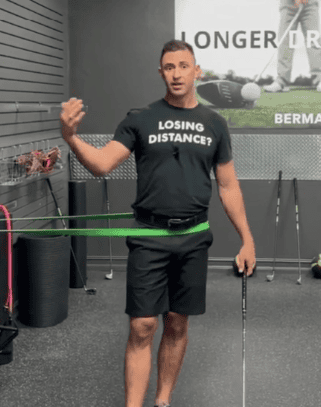
Can’t make three minutes yet? That’s fine. See where you are. Thirty seconds? Work to forty. Forty to fifty. Fifty to a minute. Build over time.
Three minutes of continuous right glute activation builds two things simultaneously. Strength—so the glute can do its job on every swing. And endurance—so it can still do that job on hole eighteen the same way it did on hole one.
When you finish the drill and immediately get into your address position and backswing, the glute fires instantaneously. Because it’s awake. Because the brain now knows what it feels like. And because the connection between the brain and the muscle is no longer a mystery.
That’s what translates to the course.
Want a Step-by-Step Blueprint?
If this resonates with you and you’re tired of advice designed for 25-year-old tour pros, I put together a simple blueprint specifically for senior golfers.
It breaks down:
- How the aging body changes
- Which muscles actually produce power
- How to gain distance without swinging harder
- How to improve consistency while reducing aches and pains
It’s written at a fifth-grade reading level with clear visuals and practical drills you can start immediately.
You can download a FREE digital copy at: 👉 gaindistance.com
No gimmicks. Just clarity on how your body should move so you can play better golf for years to come.
Bringing It All Together
You can’t generate power from a muscle you can’t feel. And you can’t feel a muscle that was never properly activated in a golf-specific position.
The resistance band drill solves both problems at once. It forces the trail foot to work. It keeps the trail knee from straightening. It demands core engagement just to stay upright against the pull. And it makes the right glute fire so hard that the brain finally has a clear signal to work from.
Three levels. Three minutes. Build the strength, the endurance, and the mind-body connection that makes the right glute a reliable power source—not an untapped one.
At Berman Golf, we focus on biomechanics first. We don’t teach cookie-cutter swings. We teach you how your body should move—especially as it ages—so you can generate power safely and repeat it under pressure.
Our in-house and online coaching programs are built specifically for senior golfers who want more distance and better consistency without beating up their bodies.
If you’re tired of advice designed for tour pros and ready for a blueprint built for your body, we’re here to help.
Because when the right glute fires on command, the power is always there.
And when the power is always there, the game gets soooooo much easier!