

One of the most overlooked keys to improving consistency in the golf swing has nothing to do with grip, swing plane, or club selection.
It comes down to how you finish the swing.
Take a look at one of my students, Michael Hines. When Michael first came to see me, consistency was a major issue. His shots were unpredictable. Some were solid, some were thin, and some completely missed the sweet spot.
The biggest change we worked on had nothing to do with his backswing.
It was his finish position.
In particular, the position of his lead leg and belt buckle at the end of the swing.

The Real Reason Many Senior Golfers Struggle With Consistency
Most senior golfers finish their swing with their belt buckle pointing somewhere to the right of the target.
Not even right-center.
More like right field.
When your body finishes in that position, but you’re trying to send the golf ball toward the target, your brain has to find another way to make the ball go where you want it to go.
And the only way it can do that is through hand manipulation.
You start flipping the club.
You start steering the face.
You start trying to control the shot at the last second.
And that leads to terrible consistency.
Because the golf swing was never designed to be controlled with the hands.
It was designed to be driven by the body.
The Key Move That Improves Consistency
To improve consistency, two things need to happen together.
First, you want to feel like the club head releases slightly to the right of the target.
That might sound counterintuitive at first.
But thinking about releasing the club to the right prevents you from forcing the club down the target line and manipulating the shot.
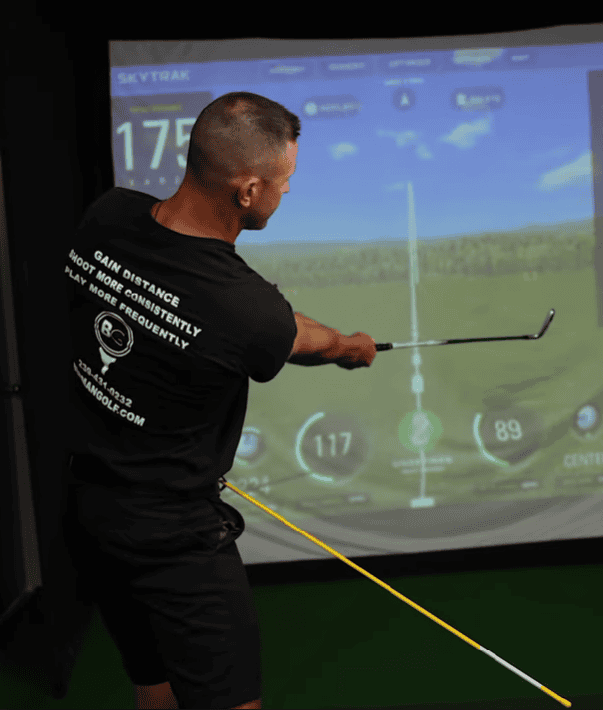
However, that feeling only works if the second piece is happening.
Your hips must continue rotating toward the target.
That means your belt buckle needs to keep turning until it points at the target.
And that rotation becomes much easier when your lead knee straightens through the finish.
When the lead knee straightens:
Your hips keep rotating.
Your belt buckle gets to the target.
And your body finishes the swing naturally.
Now your brain no longer feels the need to manipulate the club with your hands.
Why Straightening the Lead Knee Is So Important
As we get older, flexibility decreases.
Most golfers know this feeling.
Your brain still thinks you’re capable of moving the way you did in your 20s or 30s.
But your body disagrees.
When the lead knee stays bent through the finish, it blocks hip rotation.
That means the hips stop turning before they reach the target.
And when the hips stop, the hands take over.
Straightening the lead knee removes that restriction.
It allows the hips to continue rotating so the body—not the hands—finishes the swing.
That’s where consistency starts to improve.
At-Home Drill #1: The Wall Rotation Drill
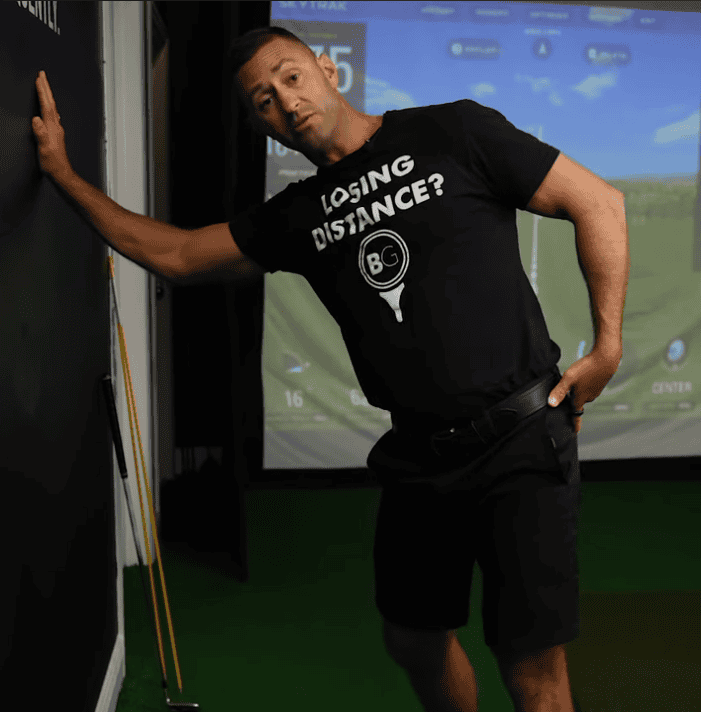
One of the safest ways to train this movement is with a simple wall drill.
Stand next to a wall and lightly hold it with your trail hand.
If you’re a right-handed golfer, that means holding the wall with your right hand.
Start with:
Soft knees
Your hips pushed slightly back
A balanced stance
From there:
Straighten your lead knee as much as possible.
Then rotate your belt buckle toward the target.
The wall gives your brain a sense of stability and safety. Because of that, your body will allow you to move in ways it normally wouldn’t.
You might feel stretching.
You might feel tightness.
It may even feel awkward at first.
That’s completely normal.
What you’re doing is teaching your body how to finish the swing correctly.
Train the Movement Without a Golf Club
Another important detail is practicing this without a golf club in your hands.
As soon as you hold a club, your brain starts thinking about hitting a ball.
That instantly makes the movement more complicated.
So keep the club out of your hands at first.
Focus entirely on the motion:
Straighten the lead knee.
Rotate the belt buckle toward the target.
Repeat the movement slowly and deliberately.
This allows your brain to learn what the body should be doing during the finish.
At-Home Drill #2: The Single-Leg Balance Test
There’s another reason many golfers struggle to finish their swing correctly.
They simply don’t have enough balance on their lead leg.
Here’s a quick test.
Stand tall and place your hands on your hips.
Now lift your trail leg straight off the ground.
Try holding that position for 10 seconds.
Don’t let your foot swing forward.
Don’t bend the knee.
Just hold the position.

If you can stay balanced for 10 seconds without wobbling all over the place, you likely have enough stability to shift your weight properly during the golf swing.
But if you can’t hold that position, your brain knows you’re unstable.
And it won’t allow you to fully shift your weight onto that lead leg during the swing.
That’s why many golfers never reach the correct finish position.
Why Balance Matters in the Golf Swing
In an efficient golf swing, roughly 95% of your weight should be on your lead leg at the finish.
If your brain doesn’t trust your ability to balance on that leg, it will never allow you to move there fully.
Instead, it keeps you hanging back.
And that incomplete weight shift leads to:
Inconsistent contact
Weak ball striking
Poor shot control
Improving your balance is often the real solution.
How to Improve Your Balance
The fix is surprisingly simple.
Every day, spend a little time practicing single-leg balance on your lead leg.
You can:
Stand next to a wall for safety.
Hold the position for several seconds.
Repeat the drill daily.
Within four to six weeks, most golfers see noticeable improvement in their balance.
Once your brain trusts that your lead leg is stable, it becomes much easier to shift your weight correctly during the swing.
And when that happens, finishing the swing with your body becomes natural.
Want a Step-by-Step Blueprint for Senior Golfers?
If you’re a senior golfer frustrated with advice designed for 25-year-old tour pros, I created a simple blueprint specifically for you.
Inside, you’ll learn:
How the aging body changes
Which muscles actually generate power
How to gain distance without swinging harder
How to improve consistency while protecting your body
The guide is written at a fifth-grade reading level and filled with simple visuals so you can quickly understand what to do.
You can download a FREE digital copy here:
No gimmicks. Just clear instruction on how your body should move so you can play better golf for years to come.
Bringing It All Together
If you’ve been struggling with inconsistent golf shots, don’t immediately blame your swing path or clubface control.
Look at your finish position.
True consistency comes from finishing the swing with your body.
When the lead knee straightens and the belt buckle rotates toward the target, the hips continue turning. When the hips continue turning, the body controls the motion of the club.
And when the body controls the motion of the club, the hands no longer need to manipulate the shot.
At Berman Golf, we teach golfers how their bodies should move—especially as they age—so they can swing efficiently and repeat it under pressure.
Because when your body moves correctly, the golf swing becomes much simpler.
And when the swing becomes simpler, consistency improves.

Dr. Jake Berman