Thin. Thick. Off the toe. Off the heel.
Every amateur golfer has a long list of excuses for why the ball didn’t do what it was supposed to do. It’s never the Indian—it’s always the arrow, right?
Wrong.
The number one cause of poor contact with irons has nothing to do with swing mechanics. It has everything to do with how you’re setting up to the ball before the swing even starts. And if you’re not a single-digit handicapper, there is a very high probability your setup is wrong in the exact way I’m about to describe.
At Berman Golf, this is one of the simplest fixes we give golfers—and one of the most immediately effective. Two adjustments. You can try them on your very next shot.
The Arc Problem Nobody Explains
Here’s the physics behind why so many amateur golfers hit their irons thin.
Every golf swing has a lowest point—the bottom of the arc. That’s where the club head is closest to the ground. That’s where the divot should start. That’s where ball-first contact happens.
When the ball is positioned in the middle or slightly forward in your stance, the lowest point of the arc is already behind the ball. By the time the club reaches the ball, it has already passed the bottom of the arc and started moving upward again.

So you catch it thin. You catch it on the upswing instead of the downswing. You scoop it instead of compressing it. And the shot that should have stuck the green with spin flies low, rolls through the back, and you’re stuck cursing the arrow instead of looking at the Indian.
The fix is so simple it’s almost annoying.
Fix #1: Move the Ball Back in the Stance
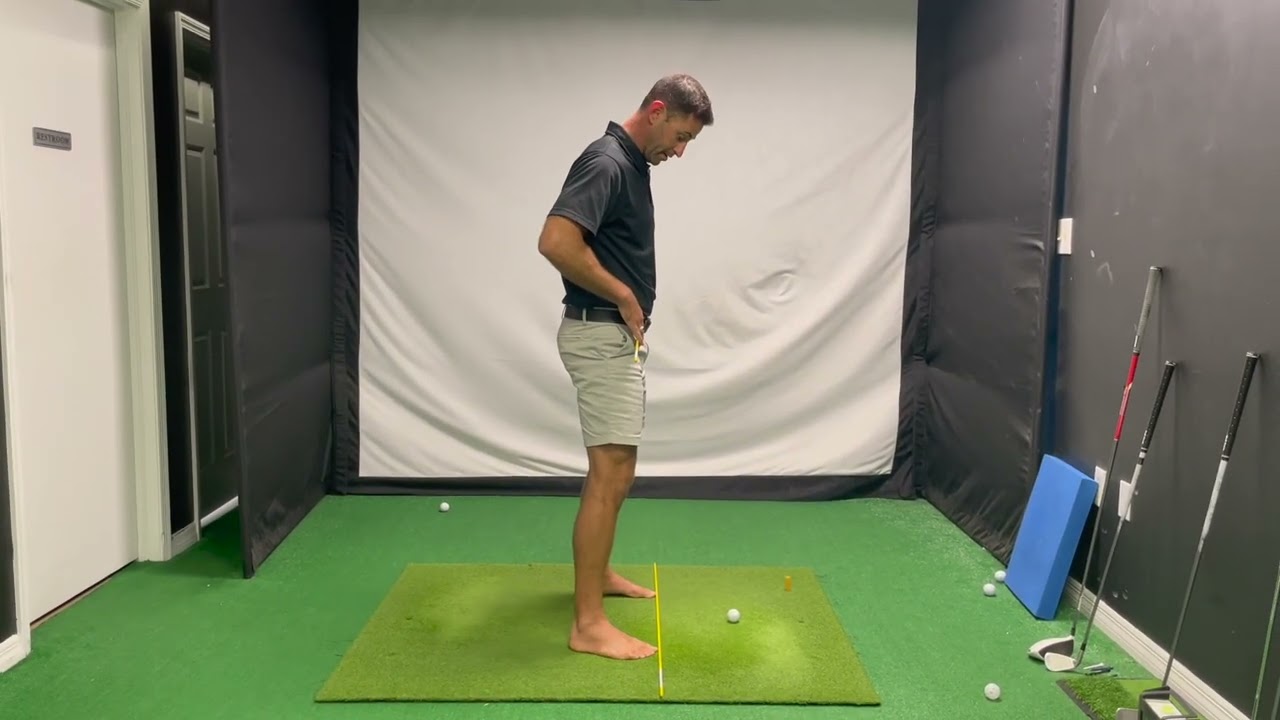
For irons, move the ball to the back third of your stance.
Not all the way back. Not middle. The back third—just a hair back from center, toward the trail foot.

That small adjustment changes everything about where the arc interacts with the ball. Now the club is still on its way down when it reaches the ball. The low point of the arc is in front of the ball—where the divot belongs. The club is descending. The ball gets compressed against the face.
That compressed ball flight is what you’ve been looking for. Low, penetrating, with spin. Lands and holds. Not the thin, running shot that screams through the green.

And here’s the thing about wedges specifically. When you look down at a wedge at address, every instinct in your body tells you to scoop it. The loft of the club, the angle, the whole visual—it screams “lift the ball into the air.”
You know you’re supposed to hit down. You tell yourself to hit down. And then you scoop it anyway because the setup is fighting you.
Moving the ball back removes that fight. The ball is now in a position where hitting down feels natural—and the loft of the club does the lifting automatically, the way it was designed to.
Fix #2: Think About Burying the Club Head in the Dirt
Here’s the mental cue that makes it all click.
Don’t think about taking a divot. Don’t think about hitting down on the ball. Think about burying the club head in the dirt in front of the ball.

Not a little divot. Bury it. Drive that club head into the ground like you want the groundskeeper to know exactly where you were standing.
That thought—aggressive, exaggerated, committed to the ground—is what produces true ball-first contact. Because when the mind is focused on a point in the dirt in front of the ball, the body naturally delivers the club on a descending path. The ball gets in the way of the club head before it reaches the dirt. That’s compression. That’s what you want.

Yes—when you first try this with real mechanics behind it, the divots will be big. Sometimes comically big. That’s actually a good sign. It means the club is hitting the ground in front of the ball instead of behind it. As the mechanics sharpen, the divots will clean up. But early on, err on the side of too much ground rather than too little. Too much ground means the ball already went. Too little means you scooped.
Work on mats first if you’re worried about tearing up the turf. Same feedback, no mess.
What Compressed Contact Actually Feels and Looks Like
When both fixes are working together—ball in the back third, mind focused on burying the club in front of it—here’s what happens.
The ball launches low and hot off the face. Then it climbs. Then it falls down with a beautiful, controlled trajectory. It hits the green with spin and stops.

That’s not luck. That’s physics. Compressed contact produces backspin. Backspin produces trajectory. Trajectory produces stopping power.
You’ve probably hit that shot once or twice—the one that felt almost effortless, barely any impact, and the ball just went perfectly. That was compression. That’s what’s available to you on every iron shot when the setup is right and the mind is focused on the ground in front of the ball.
Why Setup Matters More Than Swing for Iron Contact
Here’s the uncomfortable truth that most golfers don’t want to hear.
You can have a fundamentally good swing and still be hitting it thin consistently—just because the ball is in the wrong position at address. The setup is creating a problem the swing cannot fix.
Conversely, with the ball in the right position and the right mental focus, a swing that isn’t perfect can still produce solid, compressed contact—because the geometry is set up correctly before the club ever moves.
Fix the setup first. Always. Because the setup either gives the swing a fighting chance or makes solid contact nearly impossible no matter how good the mechanics are.
Want a Step-by-Step Blueprint?
If this resonates with you and you’re tired of advice designed for 25-year-old tour pros, I put together a simple blueprint specifically for senior golfers.
It breaks down:
- How the aging body changes
- Which muscles actually produce power
- How to gain distance without swinging harder
- How to improve consistency while reducing aches and pains
It’s written at a fifth-grade reading level with clear visuals and practical drills you can start immediately.
You can download a FREE digital copy at: 👉 gaindistance.com
No gimmicks. Just clarity on how your body should move so you can play better golf for years to come.
Bringing It All Together
If your irons are giving you thin shots, topped shots, shots off the heel or toe—before you blame the swing, look at the setup.
Ball in the back third of the stance. Mind focused on burying the club head in the dirt in front of the ball. Two adjustments. One at address, one in your head. That’s the entire fix.
The loft of the club does the lifting. Your job is to hit down and trust it. When the ball position is right and the intention is forward into the ground, compression happens naturally—and the shot that sticks the green with spin becomes the norm instead of the lucky accident.
At Berman Golf, we focus on biomechanics first. We don’t teach cookie-cutter swings. We teach you how your body should move—especially as it ages—so you can generate power safely and repeat it under pressure.
Our in-house and online coaching programs are built specifically for senior golfers who want more distance and better consistency without beating up their bodies.
If you’re tired of advice designed for tour pros and ready for a blueprint built for your body, we’re here to help.
Because when the setup is right and the club hits down, the contact is pure.
And when the contact is pure, the game gets soooooo much easier!