

If you’re a senior golfer, you can realistically shave five strokes per round by fixing just two biomechanical mistakes.
Not by buying a new driver.
Not by swinging harder.
Not by chasing speed.
But by:
- Loading your trail leg correctly in the backswing
- Initiating the downswing with the proper body part
These two errors are responsible for most inconsistency, loss of distance, and the frustrating “flip and hope” swing that keeps you stuck.
Let’s break them down.
Mistake #1: You’re Not Loading Your Trail Leg Properly
If you don’t load correctly in the backswing, the downswing is irrelevant.
Absolutely irrelevant.
Most senior golfers make this move in the backswing:
- Trail knee straightens
- Weight rolls to the outside of the trail foot
- Hips sway instead of rotate
- Spine tilts or shifts
It feels like a bigger shoulder turn.
But it’s not a true turn.
It’s a sway.

When you sway and reverse tilt in the backswing, the only way to recover is to:
- Sway back toward the target
- Early extend
- Flip the hands
- Hope you time it perfectly
And that one pure shot every few holes keeps you coming back.
That’s not a system.
That’s luck.
How to Properly Load the Trail Leg
Here’s what correct loading looks like biomechanically.
At address:
- Knees are softly flexed (not locked, not squatting)
- Weight is balanced
- Spine angle is neutral
As you initiate the backswing:
- Rotate the hips (not sway them)
- Maintain flex in the trail knee
- Apply pressure through the inside of the trail foot
- Keep the spine angle stable
You should feel:
- The trail glute working
- Pressure building inside the trail foot
- Your belt buckle rotating away from the target
When properly loaded:
- Your spine angle stays consistent
- Your hip turns until it naturally stops
- There’s no lateral sway
That’s stored power.
That’s stability.
That’s control.
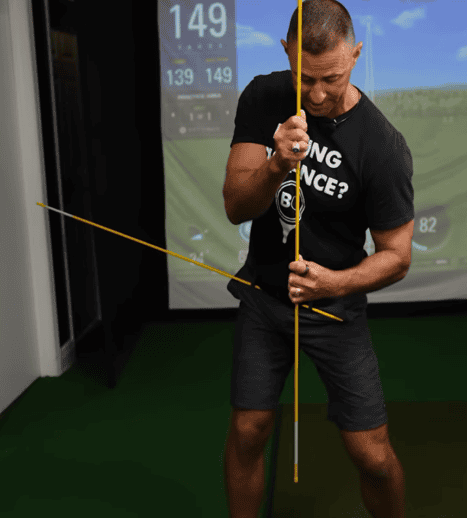
Why Shoes Can Be a Problem
Many senior golfers struggle to feel proper loading because they’re wearing:
- Tightly laced golf shoes
- Thick soles
- Orthotics that reduce foot activation
If you can’t feel the inside of your trail foot, you can’t properly load the trail leg.
Practicing barefoot—even just during drills—can dramatically improve your awareness of pressure and ground interaction.
Ground force is not optional in the golf swing.
It’s essential.
Mistake #2: You’re Initiating the Downswing With Your Arms
This is the most common sequencing error I see.
You get to the top of the backswing…
And you start down with the arms.

That leads to:
- Early extension
- Flipping at impact
- Weight staying back
- Inconsistent contact
- Loss of distance
The arms should not start the downswing.
The body should.
How to Initiate the Downswing the Right Way
The correct sequence is simple:
The belt buckle leads.
From the top of the backswing:
- Initiate by rotating your belt buckle toward the target
- Let the lower body move first
- Allow the arms to follow
When done correctly:
- The lower body begins rotating
- The upper body trails slightly
- Impact becomes compressed and powerful
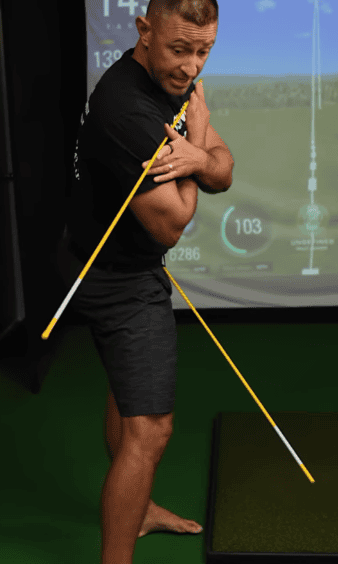
This sequencing allows energy to transfer efficiently from the ground, through the hips, into the torso, and finally into the club.
That’s how you generate effortless power.
The Impact Position You Want
At impact, exaggerate this feeling during practice:
- Lead knee straightening
- Weight shifted fully onto the lead side
- Trail foot pushing through the ground
- Trail glute firing
- Belt buckle facing the target
Hold the position.
Feel it.
Train it.
The more you exaggerate during practice, the more natural it becomes during a real swing.
“I’m Too Tight to Do This”
Many seniors believe flexibility is the issue.
It’s usually not.
It’s sequencing.
Your brain simply hasn’t learned how to:
- Activate the right muscles
- In the right order
- At the right time
That’s trainable.
Repetition builds new movement patterns.
Auditory or physical feedback drills—like alignment stick drills—can dramatically speed up that learning process.
Why These Two Fixes Shave Strokes Immediately
When you:
- Properly load the trail leg
- Initiate the downswing with the belt buckle
You eliminate:
- Sway
- Reverse tilt
- Early extension
- Flipping
- Timing-dependent contact
Ball striking improves.
Distance stabilizes.
Misses tighten.
And five strokes per round is not unrealistic—it’s common.
The Biomechanics Behind the Method
As a Doctor of Physical Therapy with over 15 years of experience working specifically with senior golfers, Dr. Berman specializes in helping aging athletes generate more power and consistency through biomechanics-based movement training.
The goal is not to swing harder.
The goal is to move correctly.
When the trail leg loads properly and the downswing sequence is correct, you don’t need perfect timing.
The swing becomes repeatable.
Want a Step-by-Step Blueprint?
If this resonates with you and you’re tired of advice designed for 25-year-old tour pros, I put together a simple blueprint specifically for senior golfers.
It breaks down:
- How the aging body changes
- Which muscles actually produce power
- How to gain distance without swinging harder
- How to improve consistency while reducing aches and pains
It’s written at a fifth-grade reading level with clear visuals and practical drills you can start immediately.
You can download a FREE digital copy at:
No gimmicks. Just clarity on how your body should move so you can play better golf for years to come.
Bringing It All Together
If you’re a senior golfer frustrated with inconsistency, start here:
- Load the trail leg properly
- Start the downswing with the belt buckle
Not the arms.
Not the hands.
Not hope.
Biomechanics.
At Berman Golf, our in-house and online programs are built specifically for senior golfers who want to move better, gain distance, improve consistency, and play more frequently without aches and pains.
Fix these two mistakes.
And you may be surprised how quickly your scores drop.

Dr. Jake Berman
Latest posts by Dr. Jake Berman (see all)
- 2 Senior Golf Swing Mistakes That Are Costing You 5 Strokes Per Round - March 13, 2026
- How Senior Golfers Can Gain 10 Yards Without Swinging Faster - March 11, 2026
- How to Increase Shoulder Turn in the Golf Swing (Without Compensations) - March 9, 2026