

If you’re a senior golfer, there’s a very high chance that at impact you look like this:
- Belt buckle facing the ball
- Hips and shoulders moving together
- Hands level with the clubhead
- No real lag
- No compression
You may think you look like a tour pro at impact.
But most senior golfers don’t.
And the reason has almost nothing to do with your backswing.
It has everything to do with your first move from the top.
The Real Problem: Everything Moves Together
From the top of the backswing, most senior golfers initiate the downswing like this:
- Hips move
- Shoulders move
- Arms move
- Hands move
All at the same time.
When that happens, your belt buckle is still pointing at the ball at impact.
If your hips aren’t ahead of your shoulders at impact, it is physically impossible to:
- Create lag
- Compress the ball
- Hit down on an iron
- Produce effortless distance
You can try to push your hands forward manually…
But you don’t have time.
You’re not 25.
You’re not on the PGA Tour.
And your body doesn’t move like it used to.
So instead of forcing positions, we retrain sequencing.
The Visual Proof: Weak vs. Powerful Impact
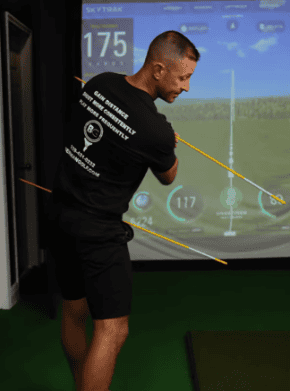
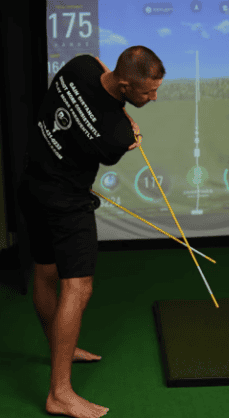
If you used two alignment sticks — one across your chest and one through your belt loops — here’s what you’d see:
Weak Impact
Both sticks are aligned together.
That means:
- Hips and shoulders rotated equally
- No separation
- No stored energy
- No lag
Powerful Impact
The bottom stick (belt buckle) is ahead of the top stick (shoulders).
That means:
- Hips led the downswing
- Shoulders followed
- Hands are trailing
- Lag is preserved
Lag is not something you “hold.”
Lag is something that happens when the lower body leads.
Why Creating Lag Feels Impossible
If your belt buckle is still pointing at the ball at impact, try this:
Attempt to push your hands forward without moving your hips.
You’ll feel stuck.
You’ll need to manipulate the club.
You’ll likely flip.
That’s exactly what most seniors do.
Not because they’re incapable.
But because the sequence is wrong.
As a Doctor of Physical Therapy with over 15 years of experience working specifically with senior golfers, I can tell you this:
Unless your entire spine is fused, you can separate your hips from your shoulders.
Your brain just hasn’t learned how yet.
The “Belt Buckle” Drill (At Home Only)
This drill is exaggerated on purpose.
And it should be done at home — not at the range.
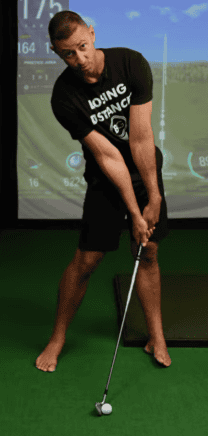
Step 1: Exaggerate the Hip Lead
From address:
- Keep your eyes on the back of the ball
- Drive your belt buckle toward the target
- Push through your trail leg
- Shift weight fully onto your lead leg
Feel:
- Right glute firing
- Core engaging
- Left side lengthening
- Left elbow straight
- Left wrist still hinged
It will feel extreme.
Good.
That’s the point.
Step 2: The “Drag” Drill (Eliminate the Flip)
Now, from that exaggerated impact position:
Using your lead hand only, drag the ball forward.
Just drag it.
Don’t hit it.
Don’t flip.
Just drag.
This trains your brain to:
- Maintain forward shaft lean
- Keep hips leading
- Eliminate hand flipping
Flipping is one of the hardest habits for amateur golfers to break.
Dragging builds a new motor pattern.
Repetition rewires sequencing.
Separate Training From Playing
Do not try to implement exaggerated drills immediately on the driving range.
Train your body first.
Then hit balls.
Your brain needs clean repetitions without performance pressure.
Once the body understands the movement, then you layer it into the swing.
Why This Changes Distance and Consistency
When the hips lead:
- Lag happens naturally
- Compression improves
- Ball flight stabilizes
- Distance increases
- Contact becomes predictable
You don’t need to swing harder.
You need to sequence better.
Want the Full Blueprint for Senior Distance?
If you’re tired of advice built for 25-year-old tour pros and want something specifically designed for senior golfers, I created a simple step-by-step blueprint.
Inside, you’ll learn:
- How to sequence your body correctly
- How to gain distance without overswinging
- How to eliminate flipping
- How to improve consistency with less strain
You can download a FREE digital copy at:
It’s written clearly, with visuals and simple drills you can implement immediately.
Bringing It All Together
If you’re struggling with:
- Flipping
- Weak contact
- Loss of distance
- Inconsistent iron play
Start with this:
Lead with your belt buckle.
Train the separation.
Eliminate the flip.
At Berman Golf, our in-house and online programs are built specifically for senior golfers who want to move better, gain distance, improve consistency, and play more frequently without aches and pains.
Because lag isn’t about strength.
It’s about sequence.
And sequence is trainable!

Dr. Jake Berman
Latest posts by Dr. Jake Berman (see all)
- Why Senior Golfers Can’t Create Lag (And How to Fix It Without Swinging Harder) - March 25, 2026
- Senior Golfers: Stop Changing Your Swing (Do This Instead) - March 23, 2026
- The Senior Golfer Pre-Shot Routine That Can Instantly Shave 5 Strokes - March 20, 2026