

Everybody loves the big stick. Nobody knows how to swing it.
Most golfers think club head speed comes from swinging the arms harder. From muscling the driver. From trying to create speed with effort.
It doesn’t. Club head speed comes from the core and the glutes.
Not the arms. Not the shoulders. The core and the glutes—the two biggest power sources in the human body—delivering everything they have into the golf ball through a properly sequenced downswing.
When the arms take over, you lose speed. You lose power. You get the slice, the pull, the chunk. And you walk off the tee frustrated knowing the ball went nowhere near as far as the effort you put in.
At Berman Golf, this is the piece that changes everything for senior golfers who want more distance off the tee. And it can be trained in five minutes with one drill done in slow motion.
The Real Source of Club Head Speed
Let’s be direct about this.
You will not gain club head speed with your arms. Full stop.
The arms are too small, too isolated, and too disconnected from the big power chain to generate meaningful speed on their own. When the arms dominate the downswing—when the shoulders come over the top and the hands pull the club down—the path goes outside to in, the face opens, and the result is a slice, a pull, or a complete loss of power through impact.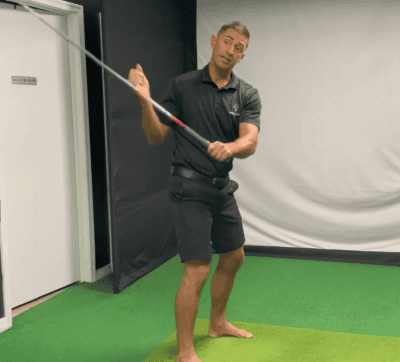
The core and glutes, on the other hand, are the largest, most powerful muscle groups in the body. When they initiate the downswing—when the belt buckle starts going toward the target before the hands do anything—they pull the club from the inside, square the face naturally, and deliver everything the body has into the ball.
That’s club head speed. Not effort. Sequencing.
The Drill: Keep the Hands High as Long as Possible
Here’s how to train your brain to initiate the downswing with the body instead of the arms.
Go to the top of the backswing. Hold it.
Now—as you start the downswing—keep your hands as high as you possibly can for as long as you possibly can.
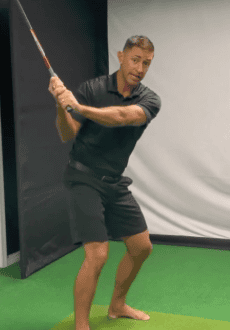
That’s the entire drill. But here’s what happens when you do it.
Because the hands are staying high and back, they can’t come over the top. The only thing that can initiate the downswing from that position is the belt buckle turning toward the target. The core has to activate. The glutes have to fire. The hips have to lead.
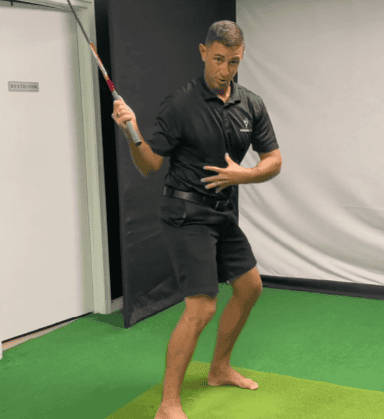
And you’ll feel it—right in the midsection and the hips—in a way you’ve probably never felt during a downswing before.
That feeling is the core and glutes doing their job. That’s the power source activating. That’s what every yard of extra distance you want is hiding behind.
Do this in slow motion. Not at real speed. Not hitting a ball. Slow motion—top of the backswing, hands stay high, belt buckle turns, feel the core and hips activate, let the hands follow naturally.
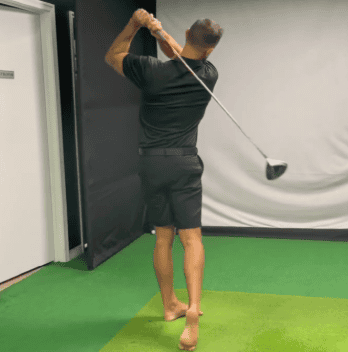
Once you can feel it consistently in slow motion, add real-time speed. Slow motion to the top. Real time down. The body has learned the sequence. Now let it execute.
The Blue Light Special: Loose Hands
Here’s the thing that breaks this drill for most people.
When you’re concentrating hard on a new movement pattern—when you’re thinking about keeping the hands high and the belt buckle going and the core firing—the grip tightens. The hands strangle the club. And tight hands kill the release.
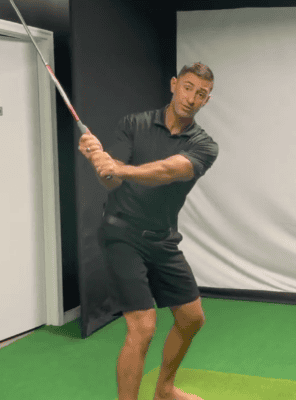
Think about using a hammer to drive a nail.
You don’t death-grip the hammer. You hold it just tight enough that it won’t fly out of your hand—and then you let the momentum of the swing drive the nail. The looseness is what creates the snap at the end. The looseness is what gives the hammer its speed.
The golf club works the same way.
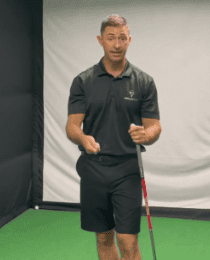
Grip pressure just tight enough that the club doesn’t fly out of your hands. That’s it. Loose hands. Let it go.
Belt buckle initiates. Hands stay high. Core and glutes drive the rotation. And then loose hands let the club release through the ball with all of that stored energy behind it.
That combination—body-initiated, loose-handed release—is what club head speed actually feels like.
Putting It All Together
Here’s the full sequence so you can run through it clearly.
Go to the top of the backswing in slow motion. Hands high and back. Belt buckle starts turning toward the target—not the shoulders, not the hands—the belt buckle. Feel the core activate. Feel the hips clear. Keep the hands as high as possible for as long as possible. Loose grip throughout. Then let it go.
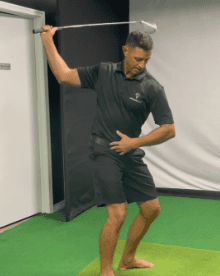
Slow motion first. Every time. Until the body knows what it feels like to have the belt buckle leading the downswing instead of the arms.
Then real time.
Once the motor pathway is built—once the brain has a clear reference for what body-initiated feels like—the speed shows up naturally. Not because you tried harder. Because the right muscles finally fired in the right order.
Why Senior Golfers Specifically Need This
Here’s the reality for golfers over 50, 60, and 70.
The arms slow down with age. The flexibility decreases. The ability to generate speed through raw athleticism and timing diminishes. And when arm-dominated golfers hit that wall, the distance just keeps dropping because the approach that worked at 40 doesn’t work at 65.
The core and glutes don’t have to slow down at the same rate. They’re bigger, they’re more trainable, and when properly activated, they can generate significantly more club head speed than the arms ever could—at any age.
But only when they’re the ones initiating the downswing. Only when the belt buckle goes first. Only when the hands stay back long enough to let the body do its job.
That’s the advantage of this drill for senior golfers specifically. It doesn’t ask you to swing harder. It doesn’t ask you to be more athletic. It asks you to sequence correctly—and sequencing is something any body can learn with the right repetitions.
Want a Step-by-Step Blueprint?
If this resonates with you and you’re tired of advice designed for 25-year-old tour pros, I put together a simple blueprint specifically for senior golfers.
It breaks down:
- How the aging body changes
- Which muscles actually produce power
- How to gain distance without swinging harder
- How to improve consistency while reducing aches and pains
It’s written at a fifth-grade reading level with clear visuals and practical drills you can start immediately.
You can download a FREE digital copy at: 👉 gaindistance.com
No gimmicks. Just clarity on how your body should move so you can play better golf for years to come.
Bringing It All Together
Stop trying to swing the driver harder with your arms. Start training the body to initiate the downswing with the belt buckle—and let the core and glutes deliver the speed the arms never could.
Top of the backswing. Hands stay high. Belt buckle turns toward the target. Core activates. Hips clear. Loose hands let it go.
Slow motion until the feeling is unmistakable. Then real time. Then the range. In that order.
At Berman Golf, we focus on biomechanics first. We don’t teach cookie-cutter swings. We teach you how your body should move—especially as it ages—so you can generate power safely and repeat it under pressure.
Our in-house and online coaching programs are built specifically for senior golfers who want more distance and better consistency without beating up their bodies.
If you’re tired of advice designed for tour pros and ready for a blueprint built for your body, we’re here to help.
Because when the belt buckle leads and the hands follow, the club head speed shows up.
And when the club head speed shows up, the game gets soooooo much easier!

Dr. Jake Berman