

You’ve probably watched Paul Wilson.
The effortless swing. Powerless arms. Fire the hips. Let the body do the work.
It looks incredible. It makes total sense. And if you’ve tried it—really tried it—you’ve probably noticed that it either didn’t work the way you expected, or it worked for a few shots and then fell apart completely.
Here’s the reason.
The effortless swing is real. The technique is sound. But it only works when the body behind it has the physical ability to execute it. And as a Doctor of Physical Therapy who has worked with senior golfers for over a decade, I can tell you that the vast majority of senior golfers do not have that physical ability yet.
That’s not an insult. It’s a diagnosis. And diagnoses have solutions.
What Paul Wilson Gets Exactly Right
Let’s start with credit where credit is due—because the concept is genuinely brilliant.
Loose arms. Relaxed grip. Letting the body drive the swing instead of the hands and arms. The idea that you turn your arms off to turn your body on.
If you could flip that switch—if you could truly drain the energy out of your arms and let the legs and hips do the work—the golf swing would be so much simpler. More consistent. More powerful. Less wear on the body.
Paul hits a drive close to 320 yards this way. His plum line at the finish is textbook—ear to shoulder to hip to knee to ankle, perfectly stacked on the left side. Lead knee straight. Lead foot planted. Not an inch of movement.
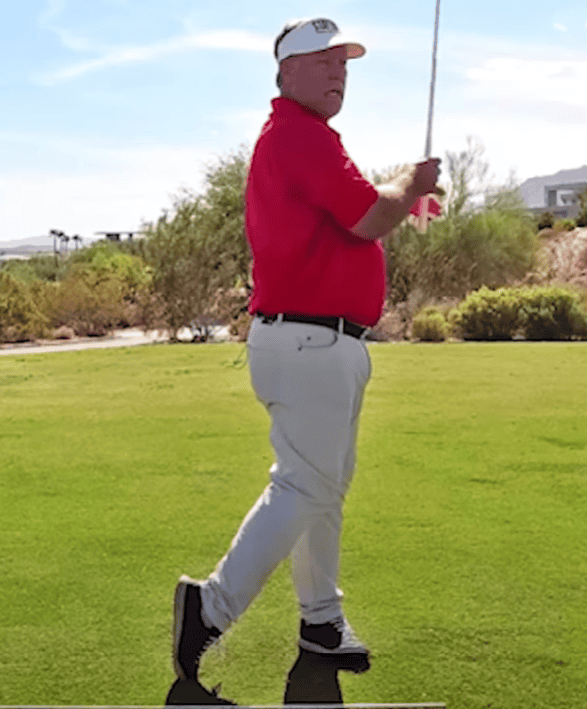
From a pure biomechanics standpoint, it is spot on. It is exactly what an efficient golf swing should look like.
The problem isn’t the technique. The problem is who it was designed for.
The Brutal Honest Truth About Senior Golfers and This Swing
In over ten years of working with senior golfers, maybe five people have had the physical ability—the strength and flexibility combination—to execute what Paul is demonstrating.
Five.
Think about that. And those were the outliers—exceptional movers for their age with nearly optimal combinations of flexibility, stability, and strength.
The other 90 to 95 percent? Technique that is subpar at best. Physical strength limitations. Flexibility limitations. And on top of all of that, they’re watching Paul Wilson and trying to implement the effortless swing.
It doesn’t work. It can’t work. Not yet.
Here’s the reality. Seven out of ten senior male golfers turn the lead foot out through impact because they don’t have the flexibility in that lead hip to keep it planted. Seven out of ten have a bent lead knee through impact and into the finish when it should be straight.
Paul’s lead foot didn’t move an inch. His lead knee is completely straight at the finish. And he has that perfect plum line stacked from ear to ankle.
For most senior golfers, none of those three things are happening. And without all three, the effortless swing doesn’t deliver what it promises—it just spins out, loses power, and sends the ball in every direction.
Why “Powerless Arms” Backfires Without the Physical Foundation
Here’s where it gets important.
The concept of powerless arms only works when something else is turned on to compensate for it. Your brain knows you’re trying to hit a golf ball. It knows distance matters to you. If you drain all the energy out of your arms and there’s nothing activated below to replace it, your brain panics—and it sends the energy right back into the arms.
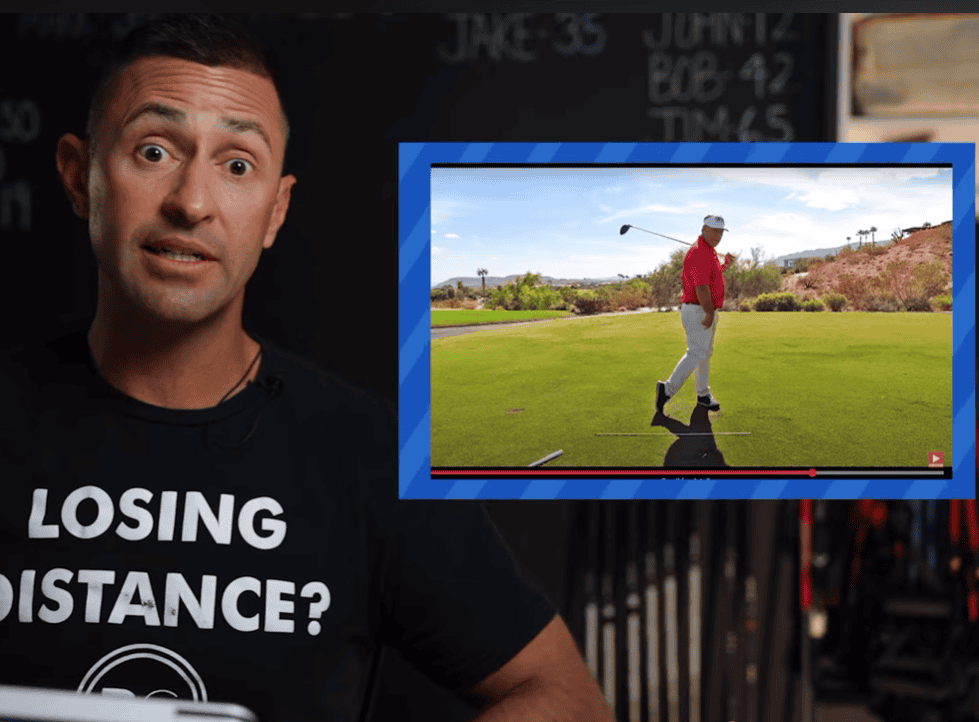
You’ve got to tighten something else up if the arms are going to be loose.
Here’s the fix.
At address, pull the belly button in toward the spine—core activated. Then think about squeezing a tomato under the arch of your trail foot. Right arch, right foot. Feel those muscles working.
Core engaged. Trail foot grounded. Now you have something firing below. Now the brain has the stability signal it needs. And from that position, relaxing the arms actually works—because the brain isn’t in panic mode anymore. It knows the body is ready to handle the load.
That combination is what allows the powerless arms concept to translate from a YouTube video into an actual golf swing.
The Discipline Problem Nobody Talks About
Here’s another piece of this that gets glossed over.
Paul suggests going slow. Taking the club back slowly. Bringing it back through slowly. Getting familiar with the feeling of loose arms and body-driven rotation before adding speed.
That’s great advice. Genuinely.
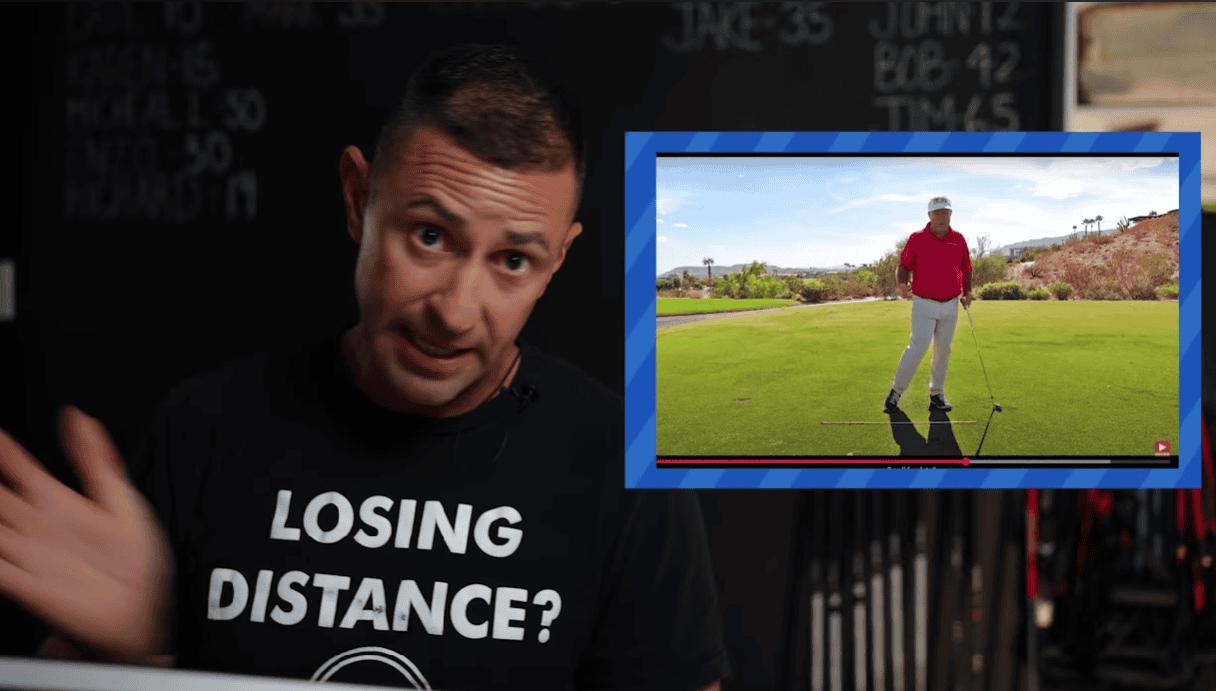
But how many of you are actually disciplined enough to do it?
How many of you can stand on the range, hit a club that normally goes 100 yards and deliberately hit it 50—full swing, slow tempo—just to feel the motion without your arms taking over?
That level of discipline is extremely rare. And here’s why it matters. If you have strength and flexibility limitations and you try to implement a slow, loose, body-driven swing without first addressing those physical restrictions, you’ll feel stuck, awkward, and out of control—and your brain will immediately go back to what it knows. The arms take over. The manipulation starts. The effortless swing disappears.
You have to fix the physical component before the technical advice has any chance of sticking.
The Lead Hip Is the Hidden Roadblock
This is the piece that most people never hear about—and it’s the reason the beautiful finish Paul demonstrates is almost impossible for the average senior golfer to replicate.
The plum line finish. Lead knee straight. Lead foot planted. Belt buckle fully rotated to the target.
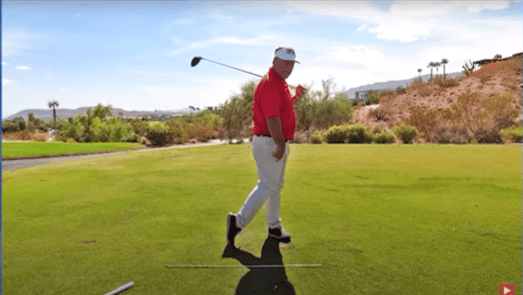
Getting there requires genuine flexibility in the lead hip. Not just a little. Enough to allow the lead knee to fully straighten while the hips continue rotating past impact into a full finish.
Seven out of ten senior male golfers don’t have that flexibility. The hip gets restricted, the knee stays bent, the foot turns out to compensate, and the whole finish collapses. The power leaks out. The ball flight suffers.
And no amount of thinking “powerless arms” changes that—because the restriction is physical, not mental.
What You Have to Fix First
Here’s the sequence that actually works for senior golfers.
Physical first. Technical second. Always.
Before you can execute the effortless swing, you need to address the specific physical limitations that are blocking it. For most senior golfers that means:
- Lead hip flexibility that allows the knee to straighten and the foot to stay planted
- Thoracic spine mobility that allows genuine rotation without compensation
- Core and glute activation strong enough to replace arm tension in the swing
- Single leg stability on the lead side to support the posted-up finish position
Start with the physical foundations. Wake up the right muscles. Build the mobility and stability the swing demands. Then—and only then—go back to Paul’s videos and implement what he’s teaching.
Because at that point, it will actually make sense to your body. The brain will have the physical evidence it needs to trust the movement. And the effortless swing becomes something you can actually execute—not just watch someone else do on YouTube.
A free five-minute warm-up routine built specifically to address these physical foundations is available at:
Do it before every round. It gets the thoracic spine moving, the hips opening, the glutes and core activating—everything Paul’s swing requires, prepared before you ever step onto the first tee.
Want a Step-by-Step Blueprint?
If this resonates with you and you’re tired of advice designed for 25-year-old tour pros, I put together a simple blueprint specifically for senior golfers.
It breaks down:
- How the aging body changes
- Which muscles actually produce power
- How to gain distance without swinging harder
- How to improve consistency while reducing aches and pains
It’s written at a fifth-grade reading level with clear visuals and practical drills you can start immediately.
You can download a FREE digital copy at: 👉 gaindistance.com
No gimmicks. Just clarity on how your body should move so you can play better golf for years to come.
Bringing It All Together
Paul Wilson is a great coach. The effortless swing is a great concept. This is not a takedown—it’s a translation.
The technique works. But it only works when the body behind it can physically execute it. And for the vast majority of senior golfers—with hip restrictions, thoracic limitations, weak glutes, and insufficient single-leg stability—the body isn’t there yet.
That doesn’t mean it can’t get there. It means you have to fix the right things first.
Core activated at address. Trail foot grounded. Lead hip mobile enough to post up. Lead knee straight through impact. Everything stacked at the finish.
Build the physical foundation. Then implement the technical advice. In that order. Every time.
At Berman Golf, we focus on biomechanics first. We don’t teach cookie-cutter swings. We teach you how your body should move—especially as it ages—so you can generate power safely and repeat it under pressure.
Our in-house and online coaching programs are built specifically for senior golfers who want more distance and better consistency without beating up their bodies.
If you’re tired of advice designed for tour pros and ready for a blueprint built for your body, we’re here to help.
Because when the physical foundation is in place, the effortless swing stops being a fantasy.
And when the effortless swing becomes real, the game gets soooooo much easier!

Dr. Jake Berman