If your elbow is hurting during or after golf, here’s the first thing most people do.
They stretch it. They ice it. They buy a brace. They do forearm strengthening exercises. They take a few weeks off and then go back to the range hoping it’s better.
And it comes back. Every time.
Here’s why. After treating thousands of people with elbow pain, I’ve discovered that 90% of them are making the same mistake. And that mistake has absolutely nothing to do with the elbow.
It has everything to do with what’s happening up in the neck and shoulder—specifically, the nerve that runs from there all the way down into the forearm. Until you address that, no amount of elbow stretching or strengthening is going to fix anything.
At Berman Golf, this is one of the most misunderstood sources of pain we see in senior golfers. And once you understand what’s actually causing it, the solution is surprisingly simple.
The Real Cause of Elbow Pain During Golf
Here’s what’s happening inside your body that nobody has explained to you yet.
You have a nerve that exits from your neck and travels all the way down through your shoulder, your arm, and into your forearm. That nerve is responsible for giving the muscles in your forearm their strength and power.
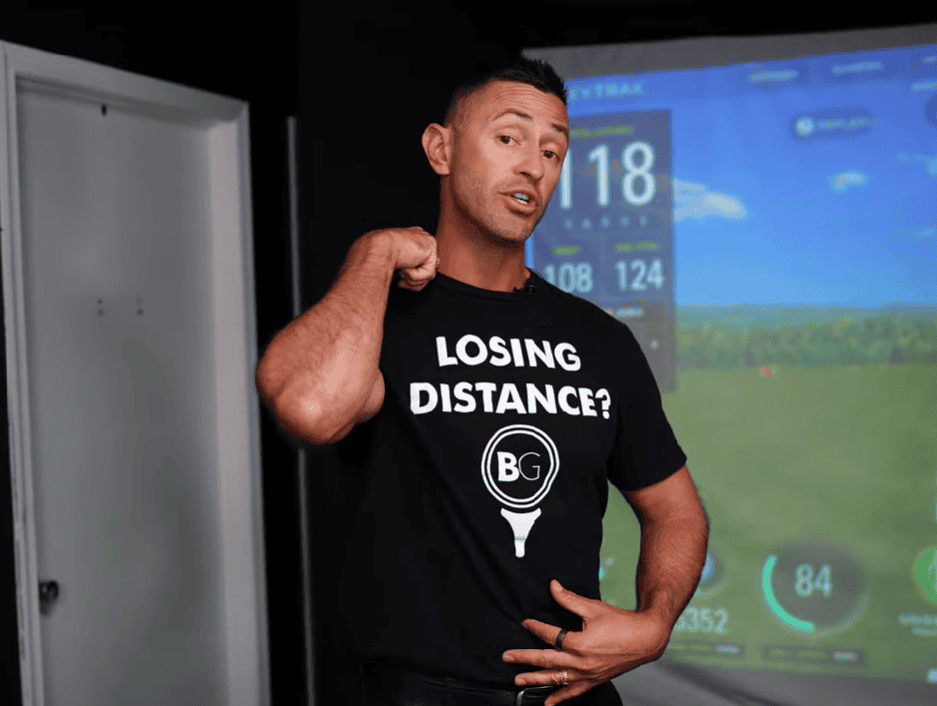
When you’re in a rounded shoulder position—chest collapsed, upper back hunched—you place compression on that nerve. And when that nerve gets compressed, it doesn’t fire correctly. The muscles in your forearm become weaker. Their ability to stabilize the club through impact is reduced.
And then you go ahead and whack the ball as hard as you can.
A weakened forearm muscle trying to manage the force of a golf swing is a forearm muscle that’s going to get hurt. Not because the elbow is damaged—because the nerve supplying it is being choked off by poor posture before you even take a swing.
That’s the cause. Rounded shoulders. Nerve compression. Weakened forearm. Pain.
Why Address Position Makes It Worse
Here’s where it gets even more direct.
Most senior golfers round their shoulders to get down to the ball at address. Not because they’re lazy—because that’s what years of habit and decreasing thoracic mobility have produced. The body finds the path of least resistance, and for most seniors, that path rounds forward.
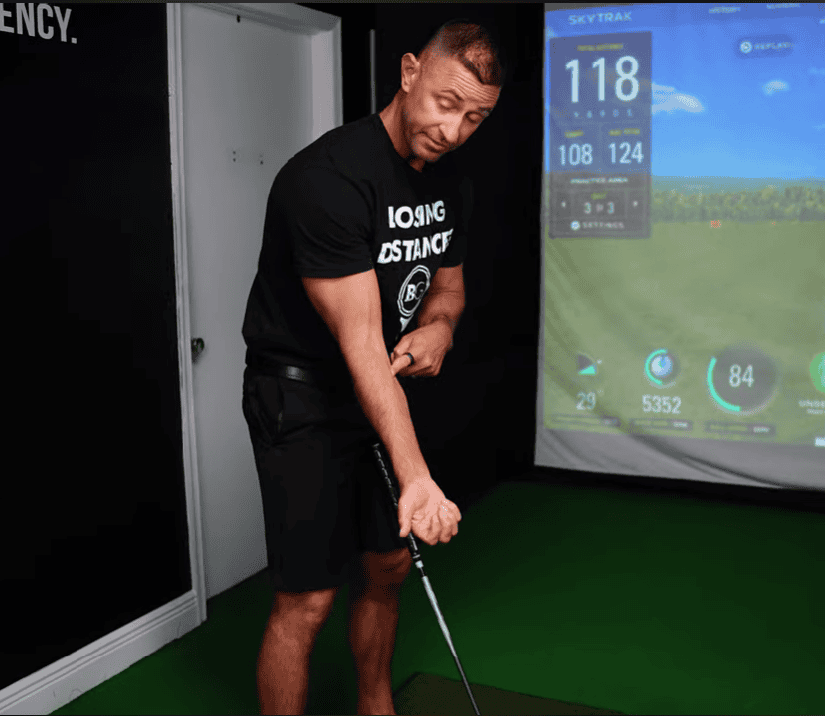
But the moment you address the ball with rounded shoulders, you have already started compressing that nerve. The forearm muscles are already weakened. And you haven’t even moved yet.
Then the swing happens. And because 90% of amateur senior golfers are arm swingers—not body swingers—you’re relying on those already-weakened forearm muscles to do the majority of the work through impact. Flipping at the ball. Whacking at it. Throwing the club head at it with the arms instead of delivering it with the body.
That combination—compressed nerve, weakened forearm, arm-dominated swing—is a recipe for elbow pain that no brace, no ice pack, and no forearm strengthening exercise is ever going to fix.
The Simple Fix: Two Exercises That Address the Root Cause
Exercise #1: The Two-Finger Drill
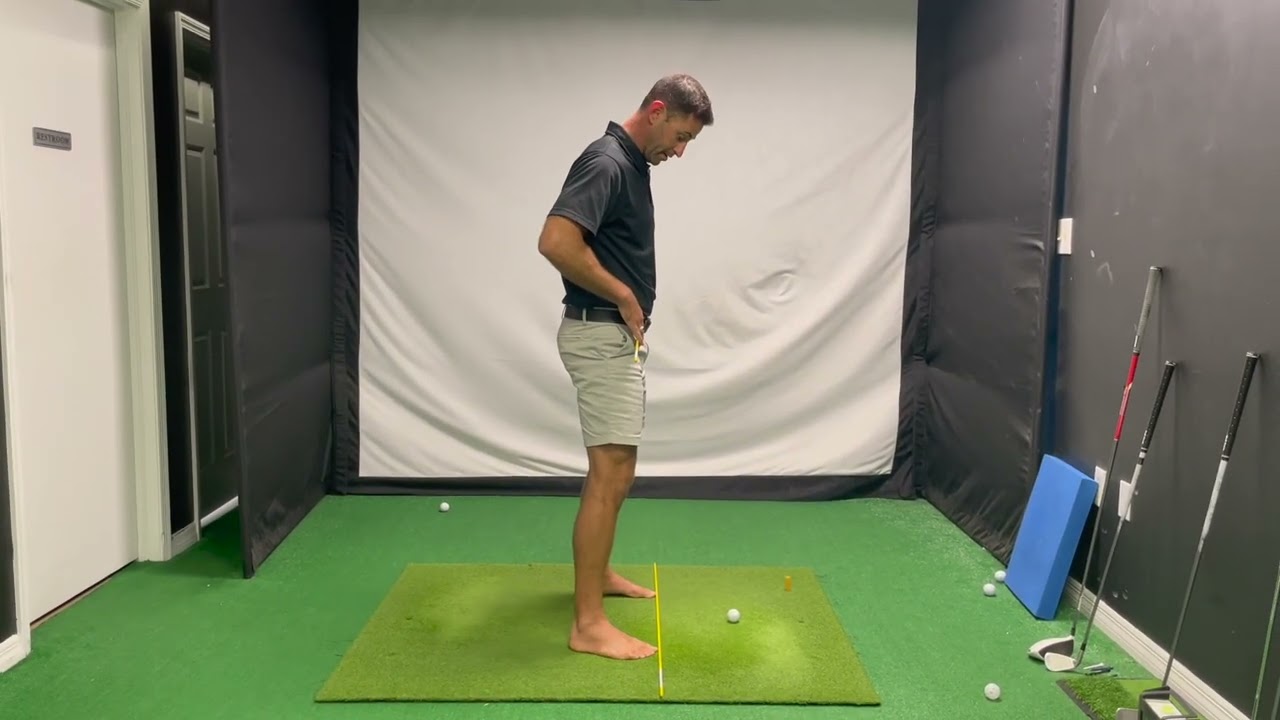
One finger in the belly button. One finger on the chest.
Pull the belly button in toward the spine. Now raise the chest as high as you can—not by arching the lower back, but by stacking through the core and lifting through the sternum.
That’s it. That single posture change immediately reduces the compression on the nerve running to your forearm. The muscles down there get their signal back. Strength returns. And the elbow has a fighting chance.
Hold this position. This is your new address position. Tall to the ball. Proud. No more old man rounded shoulders.
Exercise #2: The Palms-Out Back Activation Drill
From the two-finger drill position—belly button in, chest up—turn your palms to face the ceiling with your elbows at your sides.
Now bring your palms slowly out to the sides. Then bring them back together. Out and back. Out and back.

Think about holding a glass of water filled to the brim in each hand. Don’t spill it. That means no wrist rotation—palms stay facing up the entire time.
What this movement does is activate the small postural muscles in the middle of your back—the ones responsible for holding your chest up and your shoulders back. These are the muscles that maintain the posture needed to keep that nerve decompressed. And for most senior golfers, these muscles have been essentially asleep for years.

Squeeze those muscles at the end range. Hold for a second. Release. Repeat.
Do this drill until you can feel those mid-back muscles working clearly. Then take that same activation into your address position. Feel them holding your chest up as you hinge to the ball. That’s what keeps the nerve free. That’s what keeps the forearm strong. That’s what stops the elbow from hurting.
The Difference Is Right Here
Here’s the simplest way to understand this entire problem.
Rounded posture at address—elbow pain is going to happen.
Tall posture at address, chest up, mid-back muscles engaged—elbow pain is not going to happen.
The devil is in the details. And in this case, the detail is a quarter inch of chest lift at address that keeps a nerve from being compressed and a forearm from being weakened.
That’s it. That’s the whole fix.
If Your Posture Won’t Cooperate Yet
If you’re reading this and thinking—I understand, but I can’t even get into that upright position. My back is too stiff. I’ve been rounded for decades. I’ve been sitting at a desk for 30 or 40 years and this is just how I stand now.
Don’t give up on it. Go to:
It’s a free five-minute warm-up video designed specifically for senior golfers dealing with exactly this problem. Thoracic spine mobility. Posture activation. Mid-back muscle engagement.
Do it on the driving range before you ever swing a club. You won’t feel embarrassed doing it in front of anyone. Save it to your home screen and it works like an app.
The damage to the elbow, remember, is done before you even reach the tee box—at address, before the swing starts. A five-minute warm-up that improves posture and decompresses that nerve before you hit a single ball changes the entire equation.
Want a Step-by-Step Blueprint?
If this resonates with you and you’re tired of advice designed for 25-year-old tour pros, I put together a simple blueprint specifically for senior golfers.
It breaks down:
- How the aging body changes
- Which muscles actually produce power
- How to gain distance without swinging harder
- How to improve consistency while reducing aches and pains
It’s written at a fifth-grade reading level with clear visuals and practical drills you can start immediately.
You can download a FREE digital copy at: 👉 gaindistance.com
No gimmicks. Just clarity on how your body should move so you can play better golf for years to come.
Bringing It All Together
Your elbow is not the problem. Your elbow is the symptom.
The problem is a nerve getting compressed by rounded shoulders at address. The problem is forearm muscles being weakened before the swing even begins. The problem is an arm-dominated swing asking those already-weakened muscles to do a job they can’t safely handle.
Fix the posture. Decompress the nerve. Activate the mid-back muscles. Swing with the body instead of the arms.
Two fingers—one on the belly button, one on the chest. Palms out and back to wake up the postural muscles. Chest tall to the ball at address. Every single round.
At Berman Golf, we focus on biomechanics first. We don’t teach cookie-cutter swings. We teach you how your body should move—especially as it ages—so you can generate power safely and repeat it under pressure.
Our in-house and online coaching programs are built specifically for senior golfers who want more distance and better consistency without beating up their bodies.
If you’re tired of advice designed for tour pros and ready for a blueprint built for your body, we’re here to help.
Because when the posture improves, the nerve is free.
And when the nerve is free, the elbow stops hurting—and the game gets soooooo much easier!