

If you’re a senior golfer and your distances have been dropping, there’s a good chance nobody has told you the real reason why.
It’s not your age. It’s not your fitness. It’s not that you need to swing harder.
It’s two specific positions at the top of your backswing that are quietly draining every bit of power and club head speed you have.
And the worst part? Most golfers don’t even know they’re doing it.
At Berman Golf, this is the most common pattern I see—and once you understand what’s happening and why, the fix is surprisingly simple.
The Two Things That Are Killing Your Distance
Let’s start at the top of the backswing, because that’s where the damage is happening.
Problem #1: The Straight Trail Knee
At address, most golfers have a nice, soft bend in their trail leg. That’s correct. That bend is what allows the glutes in your trail hip to actually fire.
But watch what happens at the top of the backswing.
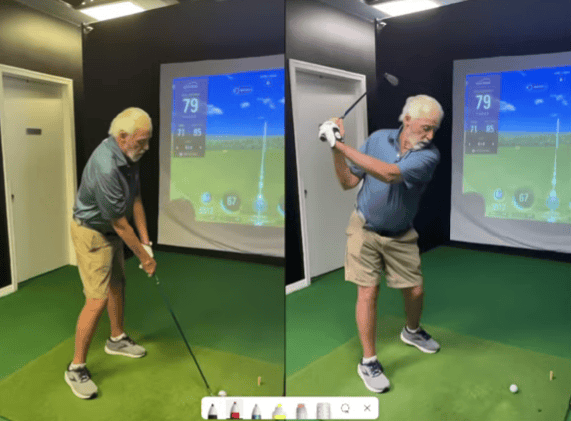
That bend is completely gone.
As a Doctor of Physical Therapy, I want to be very direct about this: it is biomechanically impossible to fire your glutes when your trail knee is fully straightened at the top of the backswing.
Not difficult. Not less effective.
Impossible.
When that knee straightens, the glutes turn off entirely. And when the glutes turn off, you have no power source. None. You’re swinging with your arms and hoping for the best.
Problem #2: The Bent Lead Elbow
Now let’s make things worse.
At the top of the backswing, the lead elbow collapses and bends.
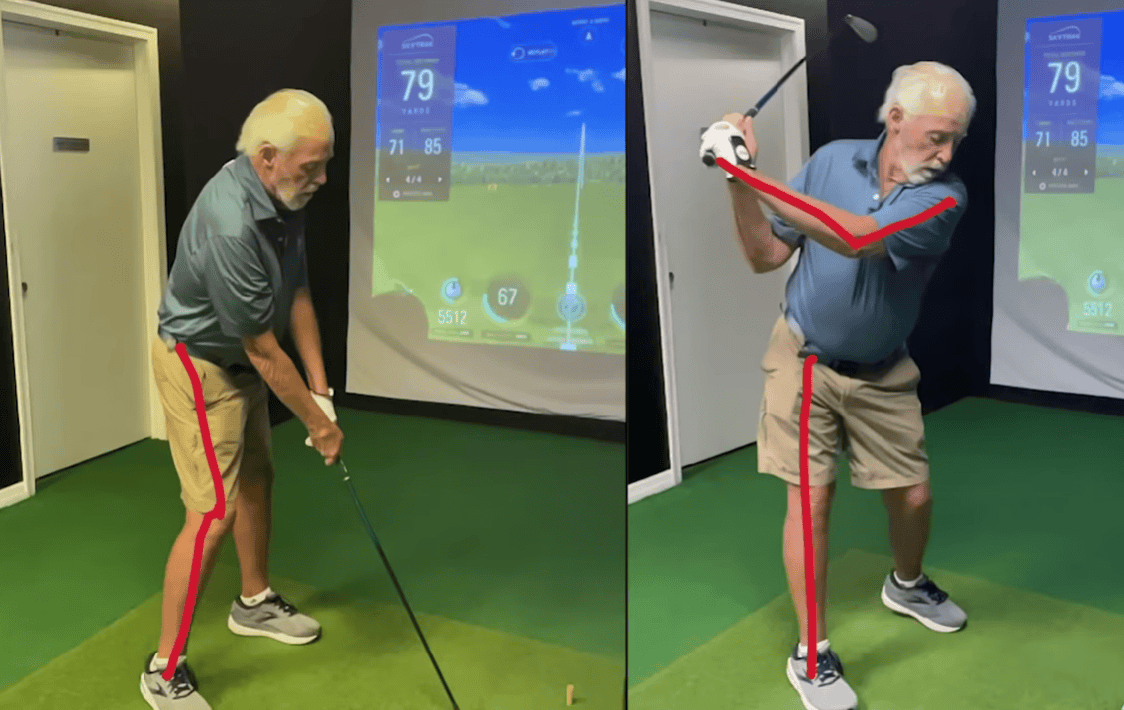
Here’s why that matters. The arc of your swing is what generates club head speed. The bigger the arc, the faster the club head moves. It’s that simple.
The moment that lead elbow bends, you’ve instantly compressed and shrunk that arc. Club head speed falls off a cliff.
Now put them both together.
Straight trail knee: no glute power. Bent lead elbow: no club head speed.
Less power. Less speed. The result? A seven iron that should go 160 yards going 75 to 80 yards.
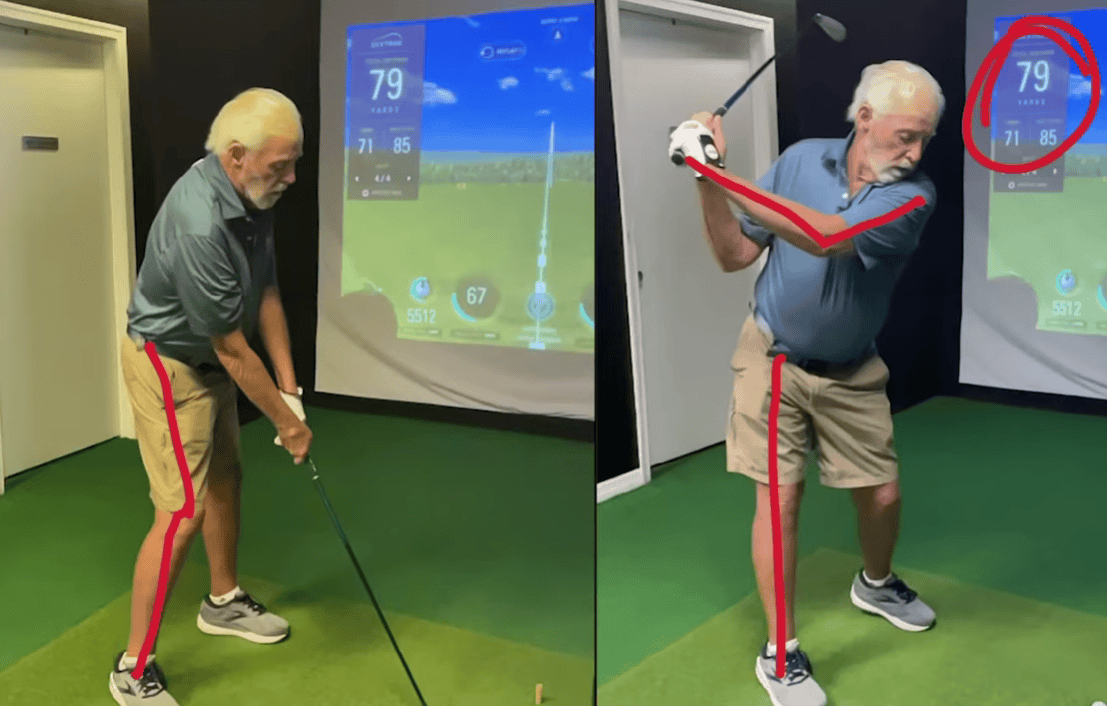
That’s not a fitness problem. That’s a positioning problem. And it has an exact solution.
The Two-Club Drill That Fixes Both at Once
All you need is two wedges. Here’s how to set it up.
Take the first wedge and wedge the club head into the corner where the baseboard meets the floor. Then take the butt end of that club and position it right behind your trail knee.
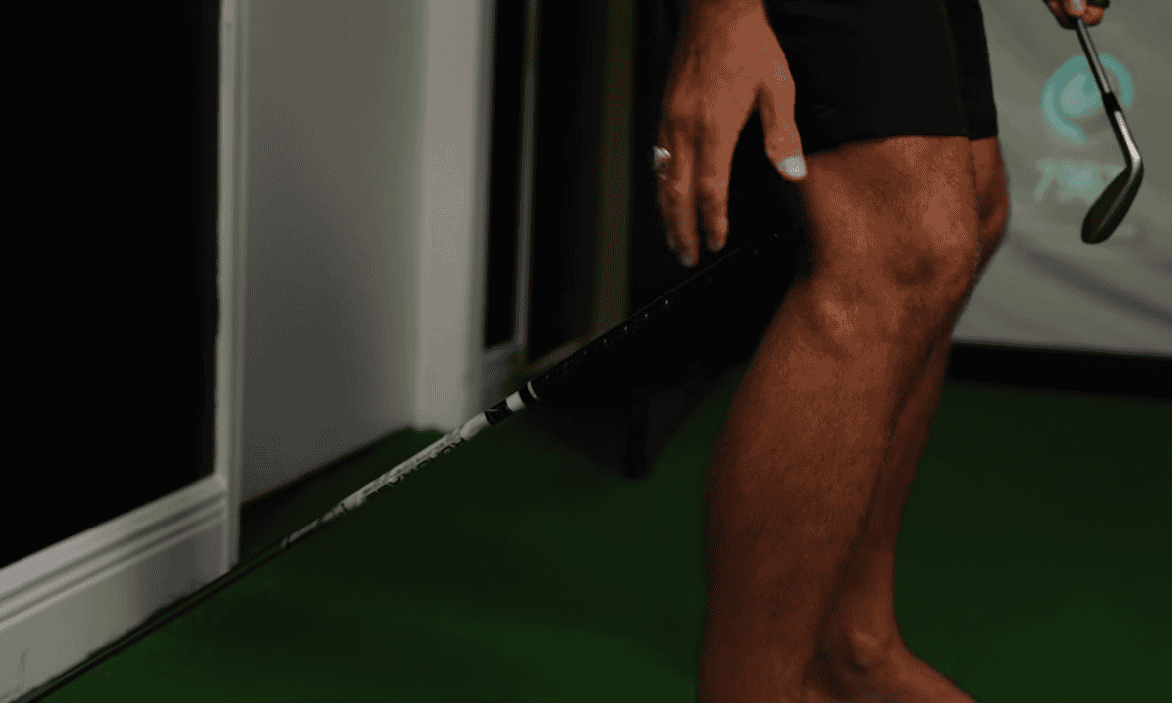
Get into your normal address position with the butt of the club sitting snugly behind that knee. Now take your trail hand and slide it halfway off the grip—like a hockey grip.
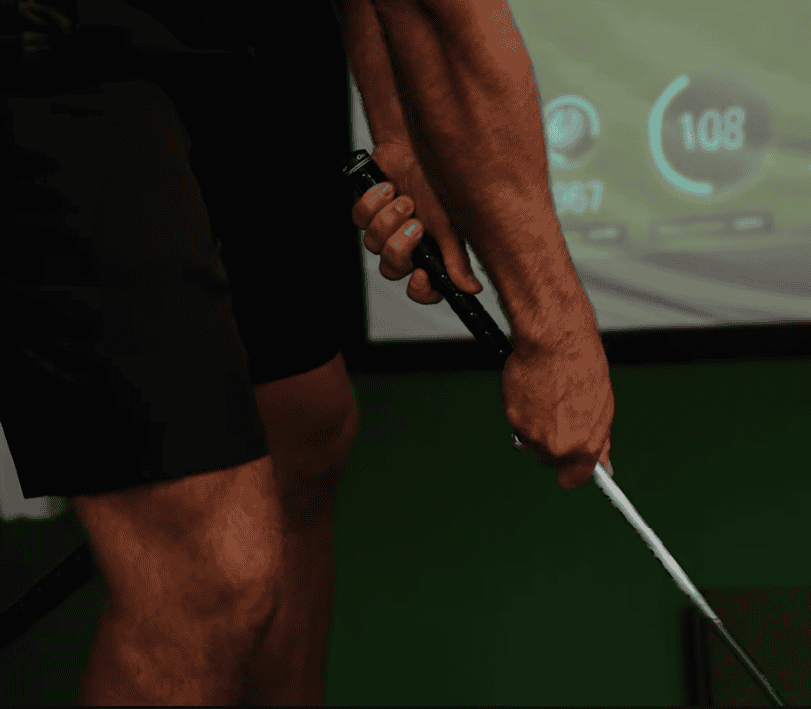
Now you’re ready for the magic.
Here’s what the club behind the knee does.
As you rotate into your backswing, it physically prevents your knee from straightening. The butt of the club keeps the bend locked in. Your glutes stay engaged. Your power source stays on.
Here’s what the hockey grip does.
With your hand positioned lower on the grip, you can use your trail arm as a fulcrum. From there, instead of wrapping the club around your neck the way most golfers do, think about pushing the knuckles of your lead hand directly away from the target.
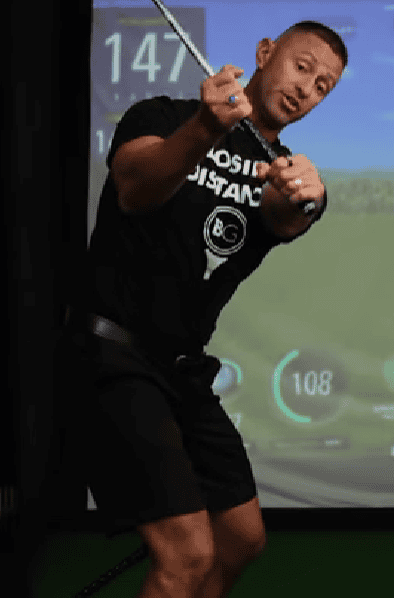
Keep your lead arm on the target line. Push the knuckles away. That motion naturally keeps your lead elbow straight and maintains the full arc of the swing.
Do this over and over again—20 to 30 repetitions. Your brain starts to learn what it actually feels like to have a straight lead elbow and a bent trail knee at the top of the backswing at the same time.
Two Pro Tips That Lock It All In
Once you’ve done the drill enough times, try removing the club from behind the knee. Keep the hockey grip and see if you can hold that bent knee position on your own.
You’ll notice it wants to straighten immediately. That’s normal. Here’s how to fight it.
Pro Tip #1: Slightly Squat Into the Trail Hip
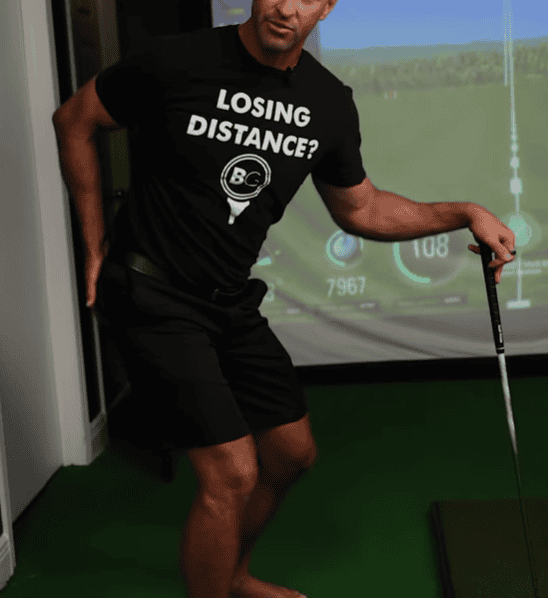
As you go into the backswing, think about slightly sitting—squatting—onto your trail hip. Exaggerate it. Really feel it.
When you’re squatting, the knee bends. When the knee bends, the glutes activate. It’s that direct.
No glutes. Glutes. That’s the whole game.
Pro Tip #2: Let the Belt Buckle Lead
As you rotate into the backswing, think about your belt buckle leading the way. Let the belt buckle drive the rotation while you maintain that squatted feeling in the trail hip.
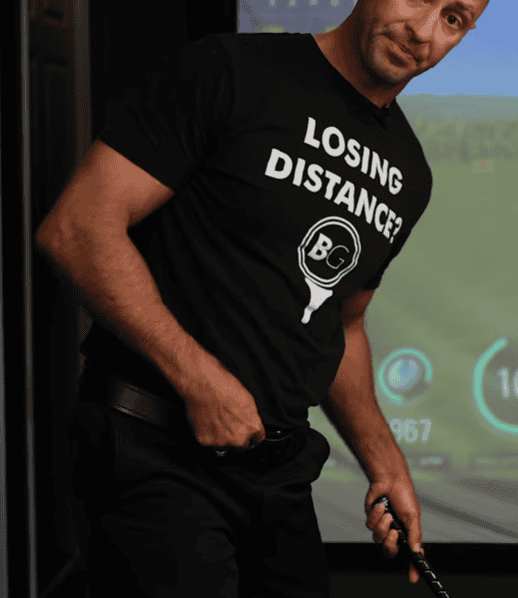
This combination maxes out your true hip turn. It maxes out your ability to contract the glutes. And it puts you in the most biomechanically efficient position your body has to offer.
That’s where real power comes from.
Why This Matters More as You Age
As a Doctor of Physical Therapy, I see this pattern every single day with senior golfers—and it’s not a character flaw. It’s a compensation.
The body gets tighter. The trail knee straightens because the hips can’t rotate as freely as they used to. The lead elbow bends because the shoulder turn runs out of road.
But here’s the thing: forcing more range of motion isn’t the answer. Positioning the body correctly within the range of motion you already have is.
When the trail knee stays flexed:
- The glutes fire
- The power source turns on
- The body can actually load
When the lead elbow stays straight:
- The arc stays wide
- Club head speed climbs
- The ball goes further
Both problems. One drill. Two wedges.
Want a Step-by-Step Blueprint?
If this resonates with you and you’re tired of advice designed for 25-year-old tour pros, I put together a simple blueprint specifically for senior golfers.
It breaks down:
- How the aging body changes
- Which muscles actually produce power
- How to gain distance without swinging harder
- How to improve consistency while reducing aches and pains
It’s written at a fifth-grade reading level with clear visuals and practical drills you can start immediately.
You can download a FREE digital copy at: 👉 gaindistance.com
No gimmicks. Just clarity on how your body should move so you can play better golf for years to come.
One Rule Before You Take This to the Range
Don’t rush this.
Practice the two-club drill at home until the positions feel automatic. Until your brain knows exactly what a bent trail knee and a straight lead elbow feel like at the top—without having to think about it.
Then take it to the range.
If you skip that step and go straight to hitting balls, the brain gets distracted by impact, and everything falls apart. Build the pattern first. The range rewards the prepared.
Bringing It All Together
If your distances have been dropping and nobody has been able to explain why, look at these two positions.
Trail knee at the top of the backswing—is it still bent?
Lead elbow at the top of the backswing—is it still straight?
If either answer is no, you’ve found your distance leak. And now you have the exact drill to fix it.
At Berman Golf, we focus on biomechanics first. We don’t teach cookie-cutter swings. We teach you how your body should move—especially as it ages—so you can generate power safely and repeat it under pressure.
Our in-house and online coaching programs are built specifically for senior golfers who want more distance and better consistency without beating up their bodies.
If you’re tired of advice designed for tour pros and ready for a blueprint built for your body, we’re here to help.
Because when the trail knee stays loaded and the arc stays wide, the power comes back.
And when the power comes back, the game gets soooooo much easier!

Dr. Jake Berman