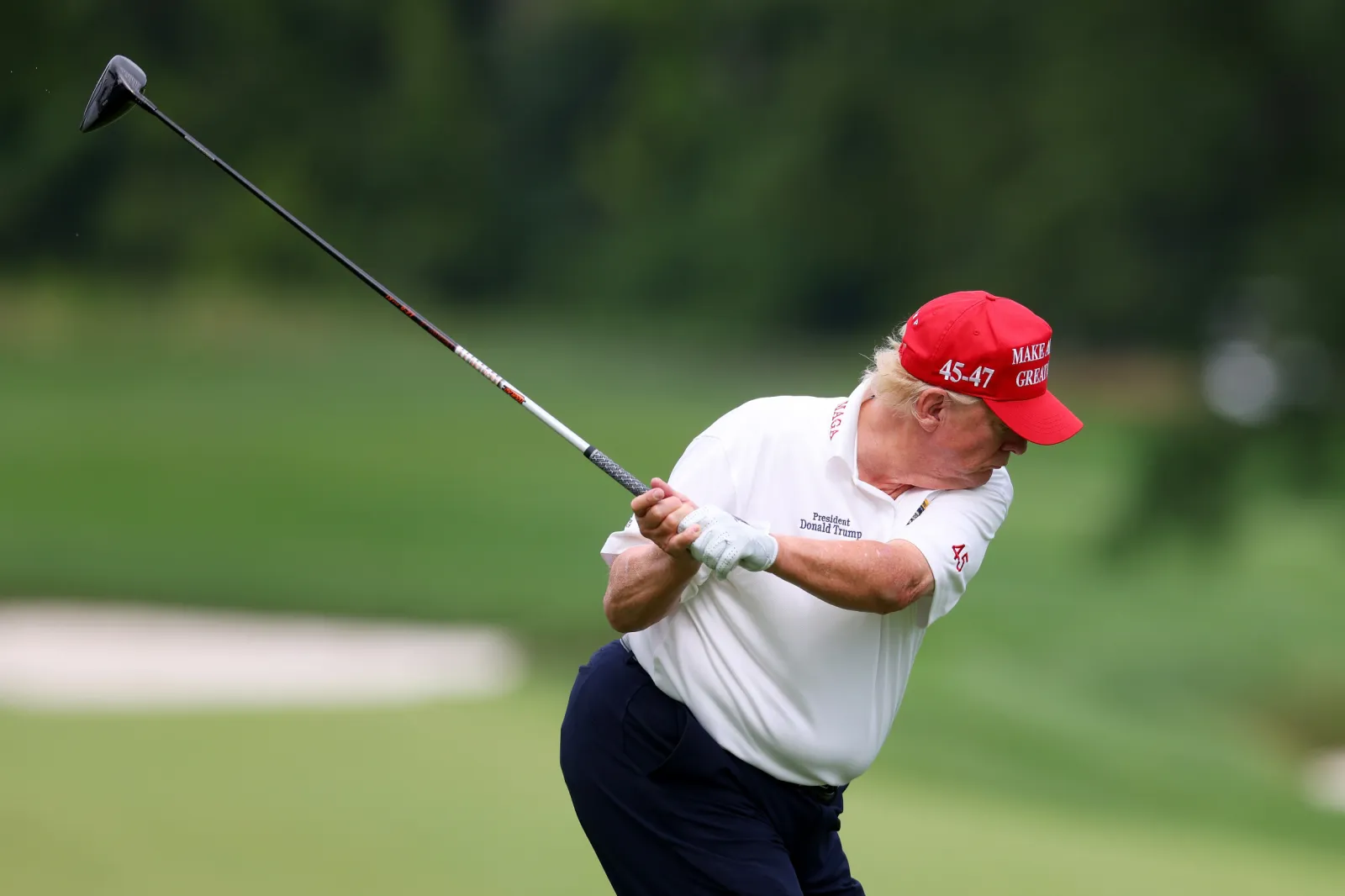
Most golf instruction tells you to fix your swing until it looks like the textbook.
Square stance. Square shoulders. Big turn. Full extension.
But what if your body can’t do that anymore? What if the textbook was written for someone 30 years younger than you?
Here’s something most golf instructors won’t tell you: some of the smartest golf in the world is being played by people who’ve completely stopped fighting their physical limitations—and started using them instead.
And one of the clearest examples of that is Donald Trump.
At Berman Golf, we analyze swing mechanics through a biomechanics lens. And what we see in this swing analysis might surprise you.
First, Let’s Talk About What a Great Senior Swing Actually Looks Like
Before we get to Trump, let’s look at what we’re working toward.
In this footage, we catch a glimpse of a senior golfer named Donnie doing something most seniors never do—getting the hips way out in front, posting up tall on that lead leg, maintaining spine angle, and keeping the hands and club on the correct plane through impact.
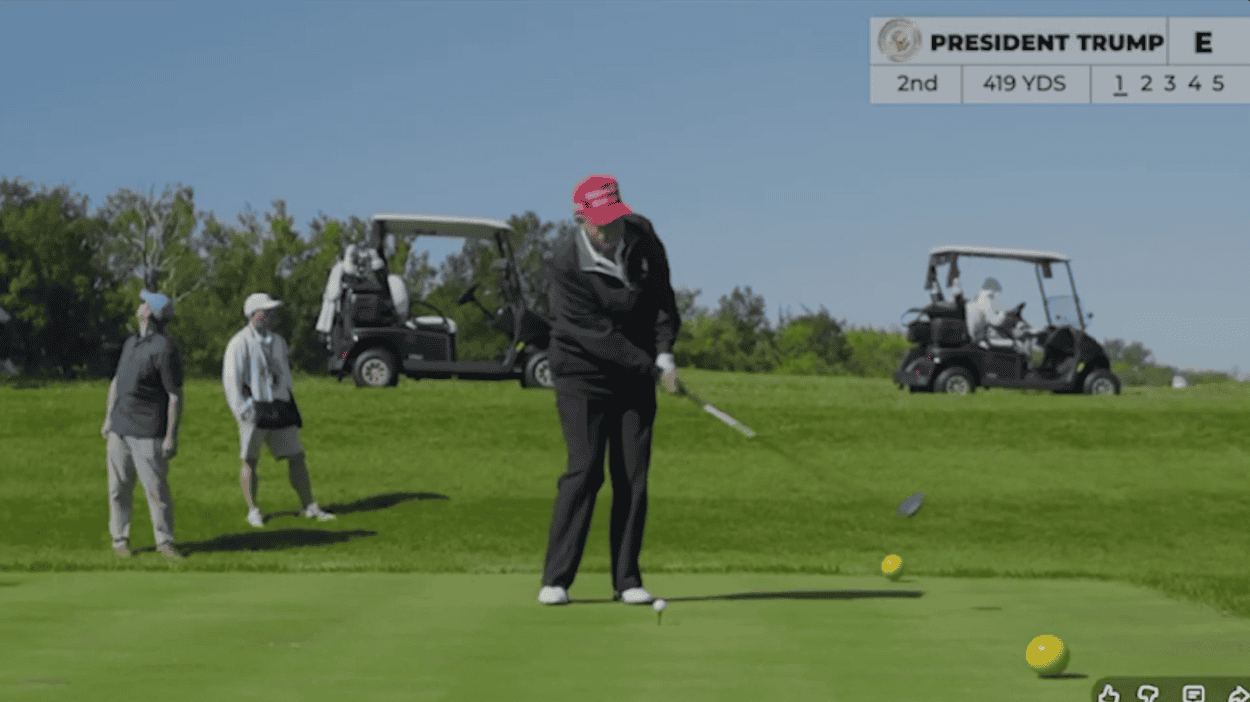
Watch how far the hips are leading. That separation between the hips and the hands is where power lives. Most seniors flip at the ball because the hips stall and the hands have to rescue the shot. Donnie’s hips are doing exactly what they should—clearing the way so the hands never have to flip.
That’s the goal. Hips lead. Body finishes. Hands just come along for the ride.
The 18-Year-Old Who Hit It 237 Yards Into the Wind
Now here’s the contrast.
An 18-year-old named Kai steps up on a 337-yard hole and drives it 237 yards—into the wind.
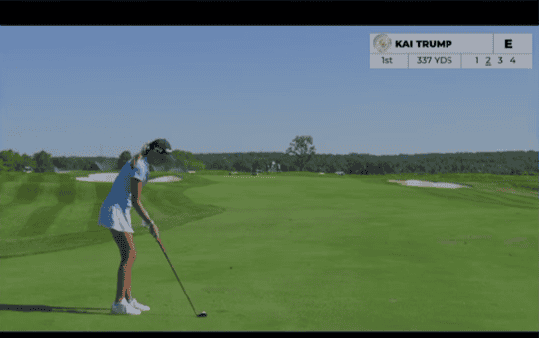
Look at what she’s doing. Feet closed. Aiming way left of the target. And then she does something that looks completely crazy—she swings way over the top and curves the ball back to the flag.
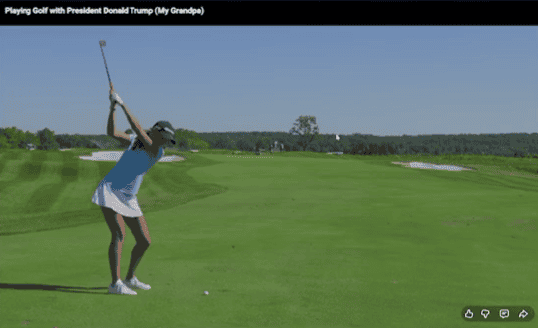
Look at the length of her swing. From the trail heel all the way up to the top of the club head—the arc is enormous. Lead arm perfectly straight. Trail knee loaded and flexed. Glutes firing. Club head speed through the roof.
It is, biomechanically speaking, a picturesque golf swing.
And then here’s the critical point:
Seniors—you’re not going to do that. It’s not going to happen.
She can aim left and swing over the top because she has the flexibility to recover. She can manufacture a result from a compromised position because her body can unwind fast enough to make it work.
A senior body cannot do that. When you aim left and swing over the top, you don’t get a beautiful push-fade. You get a banana slice that finds the next zip code.
The physical ability to pull off those compensations disappears as the body ages. So the question becomes: what do you do instead?
The Senior Compensation That Quietly Ruins Everything
Here’s the pattern we see constantly with senior golfers who have played for decades.
Back in your 20s or 30s or even 40s, you developed some kind of compensation. Maybe you aimed a little left. Maybe you came over the top. Maybe you had a funky grip or an unusual setup.
And it worked—because you had the physical ability to recover from it. You were flexible enough, fast enough, and strong enough to manufacture a shot even from an imperfect position.
But now the flexibility is gone. The recovery speed is gone. The compensation that used to work is still there—but the physical ability to support it isn’t.
That’s why the same swing that gave you decent results at 45 is costing you 30 yards and three fairways at 65.
The swing didn’t change. The body did.
Now Let’s Talk About Trump
Here’s where this gets interesting.
Look at his setup. His feet are aimed way left—toward the golf carts on the left side of the frame. The sand trap is straight ahead. The golf carts are where his feet are pointing.
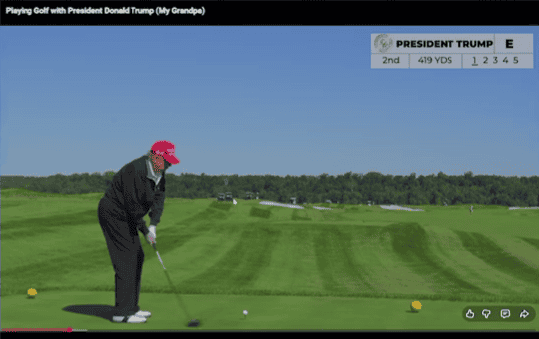
That is an extreme open stance. Most instructors would look at this and immediately try to square him up.
But watch what happens.
He comes way over the top—way across the ball—which with a square stance would produce a pull or a snap hook. But because his stance is so open, that over-the-top path actually turns into a push-fade. The ball starts right and curves back toward the target. It’s playable. It’s repeatable. And he’s been doing it long enough that he does it over and over with full confidence.
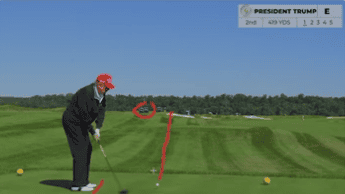
He’s not fixing his flexibility limitation. He’s designing around it.
He knows he can’t make a big back turn. So instead of forcing one, he opens his stance so that the rotation he does have—combined with his over-the-top path—produces a consistent, predictable result.
That’s not a bad golf swing. That’s smart golf.
The Biggest Takeaway: Hips Lead, Every Time
Across every swing in this analysis—Donnie’s, Kai’s, and Trump’s—there is one common thread in the shots that work.
The hips lead.
When the hips are clearing through the ball, the hands don’t have to flip. The club delivers naturally. The body does the work it was designed to do.
When the hips stall, everything breaks down. The hands panic. The flip happens. Power disappears.
Trump has done this long enough and often enough that his brain and his body work together automatically. That confidence—that deep-seated trust that the move is going to happen—is what allows him to repeat it under pressure, round after round.
That’s the goal for every senior golfer reading this.
Not a perfect, textbook swing.
A repeatable swing. One that works within your body’s actual limitations. One your brain trusts completely.
Why This Is Especially Important for Senior Golfers
The vast majority of seniors who have played for decades built their swing around physical abilities they no longer have. The compensations they developed in their 20s and 30s made sense then.
They don’t make sense now.
As a Doctor of Physical Therapy, I’ve seen this pattern hundreds of times. The golfer isn’t doing anything wrong in terms of effort or intent. They’re just running a program that no longer matches the hardware.
The answer isn’t to try to get back to a 25-year-old body. The answer is to understand what your body can do right now—and build a swing that works with it, not against it.
That starts with the hips. It starts with getting those hips clearing to the target so the hands never have to manipulate anything. And it starts with accepting that your swing doesn’t need to look like a tour pro’s—it just needs to work.
Every single time.
Want a Step-by-Step Blueprint?
If this resonates with you and you’re tired of advice designed for 25-year-old tour pros, I put together a simple blueprint specifically for senior golfers.
It breaks down:
- How the aging body changes
- Which muscles actually produce power
- How to gain distance without swinging harder
- How to improve consistency while reducing aches and pains
It’s written at a fifth-grade reading level with clear visuals and practical drills you can start immediately.
You can download a FREE digital copy at: 👉 gaindistance.com
No gimmicks. Just clarity on how your body should move so you can find more fairways, stick more greens, and play better golf for years to come.
Bringing It All Together
The best senior golf swing isn’t the prettiest one. It’s the most repeatable one.
Trump’s swing looks unconventional because it is. But it works—consistently, confidently, and within the physical limitations of an aging body. That’s not something to laugh at. That’s something to study.
Get the hips leading. Design your setup around what your body can actually do. Stop chasing the swing you had at 35.
At Berman Golf, we focus on biomechanics first. We don’t teach cookie-cutter swings. We teach you how your body should move—especially as it ages—so you can generate power safely and repeat it under pressure.
Our in-house and online coaching programs are built specifically for senior golfers who want more distance and better consistency without beating up their bodies.
If you’re tired of advice designed for tour pros and ready for a blueprint built for your body, we’re here to help.
Because when the hips lead and the body finishes, the hands never have to flip.
And when the hands stop flipping, the game gets soooooo much easier!