

Here’s the honest question most golfers never ask themselves.
Do you actually know what it feels like to fire your glutes during the golf swing?
Not in a bridge. Not in a squat. In the golf swing—in that half-hinged, rotating, tri-planar position that nothing else in your daily life replicates.
If you’re not sure, that’s the whole problem. Because you can do glute bridges every morning, you can squat in the gym three days a week, and still show up to the first tee with glutes that are completely checked out during the backswing.
The muscle isn’t weak. The connection isn’t there. And without the connection, the strength you built in the gym never makes it to the golf ball.
At Berman Golf, this is the first thing we address when a senior golfer tells us their power has disappeared. Not technique. Not equipment. The brain-to-glute connection. And this drill is the simplest, most effective way we’ve found to build it.
Why the Core Has to Come First
Before the glutes can fire, the core has to be on.
This isn’t a coaching preference. It’s physiology. The core and the glutes are connected in the body’s neuromuscular chain. When the core isn’t engaged, the glutes genuinely struggle to activate efficiently. It’s an efficiency thing—the body’s wiring requires the core to be on before the glutes get a clean signal.
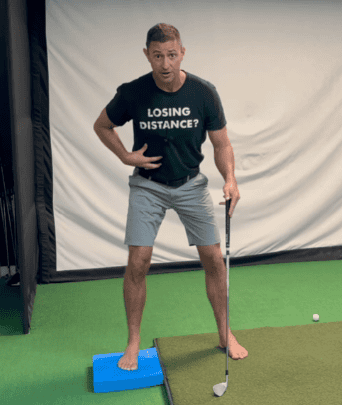
So before anything else—pull the belly button in toward the spine. Think about bracing for a little sucker punch to the gut. That tension in the midsection is the core turning on. Hold it. Keep breathing. Now you’re ready to find the glutes.
The Drill: Foam Pad, Address Position, Tiny Baby Squat
Here’s the setup.
Place a foam balance pad—or a firm pillow—under your trail foot. Stand in your address position on the pad with the trail foot. The instability of the soft surface makes the muscles in the foot and the glute work harder to stabilize, which makes the glute significantly easier to feel.
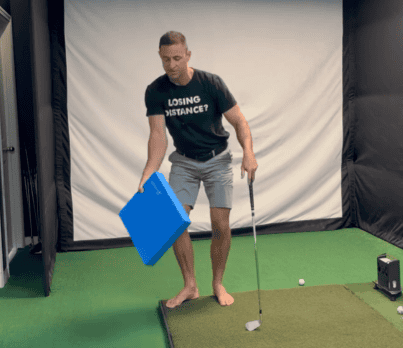
Core engaged. Now start gradually increasing the pressure through the trail foot—think about pushing the foot straight down through the foam pad toward the ground.
Here’s the key that makes everything work.
As you push the foot down, reach the butt slightly back. A tiny baby squat. Barely anything. Not a full squat—just a small backward reach of the trail hip, like you’re reaching for a bar stool a few inches behind you.
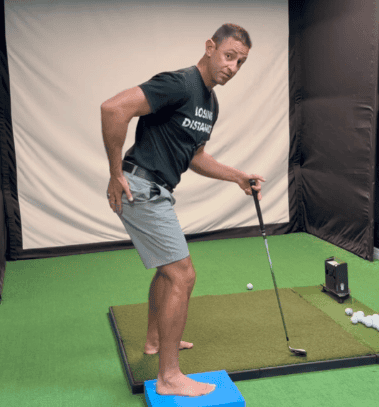
Don’t let the knee push forward. Don’t let the head sway. Just press the foot down and reach the butt back—and if the core is engaged when you do it, you will feel the glute.
Immediately. Right there. That’s it.
That sensation—that firing in the trail glute—is the thing you’ve been trying to reproduce in your backswing. The drill makes it impossible to miss. Because the foam pad demands stability, the foot has to work. And when the foot works with a bent knee and an engaged core, the glute has no choice but to fire.
Now Keep It Firing Into the Backswing
Here’s where the real training happens.
Once you can feel the glute firing in the address position—once that connection is clear and undeniable—go into the backswing and try to keep it firing.
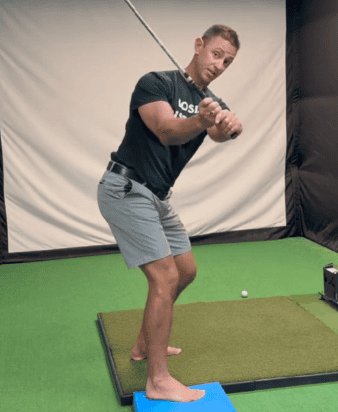
This is where most golfers lose it. The backswing starts and the trail knee straightens. The moment that the knee straightens, it is biomechanically impossible to fire the glute. The connection cuts off. The power source disappears. And the arms take over to fill the gap.
Keep the knee bent as you rotate. Keep the foot pressing into the pad. Keep the butt reaching back. Keep the core engaged.
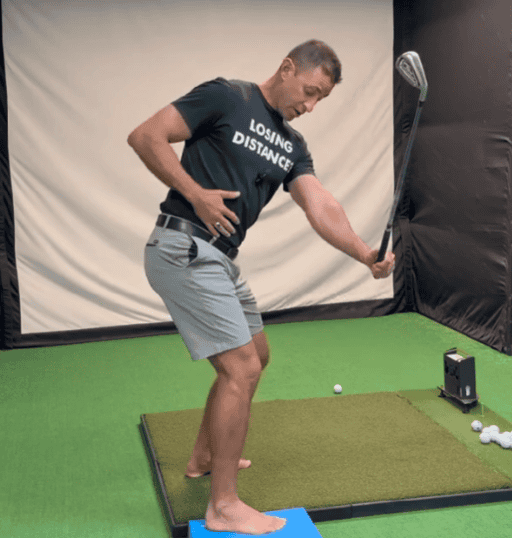
At the top of the backswing, the glute should be screaming. If it’s not, the knee straightened somewhere during the rotation and the connection was lost. Go back to the address position, reestablish the feeling, and try again.
Do it over and over. Don’t try to hit a ball yet. Don’t try to put it all together with a real swing yet. Just go from address to the top of the backswing—feeling the glute the entire way—and come back.
The Progression: Soft Surface to Hard Surface, Reps Before Results
Here’s the order that makes this drill actually stick.
Start on the foam pad. Build the feeling. Exaggerate the baby squat so the brain gets a loud, clear signal of what glute activation actually feels like in a golf position.
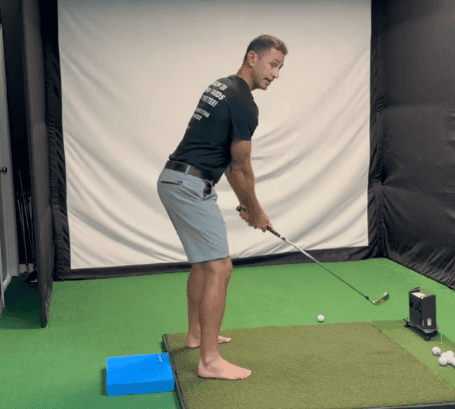
Once the feeling is consistent on the soft surface—once you can get to the top of the backswing and feel the glute working clearly—move to a hard surface and do it again.
The hard surface removes the assist. The muscles in the foot have to work harder on their own. The glute has to activate without the foam pad amplifying the signal. And that’s where the real neural pathway gets built.
Get in fifty repetitions. Then a hundred. Not fifty reps over a week—fifty reps in a session, back and forth, over and over, until the movement from address to the top of the backswing with a firing glute starts to feel automatic.
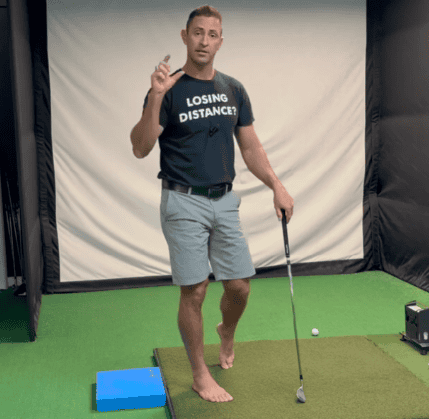
Only after those reps—only after the brain has built a clear, reliable reference for what this feels like—should you attempt to use it in an actual swing.
That’s the sequence. That’s the order. Skipping it leads to the driving range version of this drill, where you try it once on a ball and it falls apart—because the motor pathway wasn’t built yet.
Build the pathway. Then use it.
Why This Matters More Than Any Exercise You’re Already Doing
This is the gap that gym exercises can’t fill.
A glute bridge fires the glute in a lying-down, single-plane movement with no rotation, no hip hinge, no foot pressure demands, and no weight shifting. It builds strength in a position that shares almost nothing with the golf swing.
This drill fires the glute in a hinged, rotating, weight-bearing position—exactly the position the golf swing demands. The brain learns to activate the glute where it actually needs to be activated. Not in the gym. In the swing.
That’s the difference between general fitness and golf-specific training. And for senior golfers who want to get real power back, golf-specific is the only version that shows up on the course.
Want a Step-by-Step Blueprint?
If this resonates with you and you’re tired of advice designed for 25-year-old tour pros, I put together a simple blueprint specifically for senior golfers.
It breaks down:
- How the aging body changes
- Which muscles actually produce power
- How to gain distance without swinging harder
- How to improve consistency while reducing aches and pains
It’s written at a fifth-grade reading level with clear visuals and practical drills you can start immediately.
You can download a FREE digital copy at: 👉 gaindistance.com
No gimmicks. Just clarity on how your body should move so you can play better golf for years to come.
Bringing It All Together
You can’t use a muscle you can’t feel. And you can’t feel a muscle that was never properly connected to the golf swing in the first place.
The foam pad drill solves that. Core engaged first. Trail foot pressing into the soft surface. Tiny baby squat reaching the butt back. Glute fires immediately. Then carry that firing glute into the backswing—trail knee bent, belt buckle turning, connection maintained all the way to the top.
Fifty reps on the soft surface. Fifty more on the hard surface. Build the motor pathway until the brain can find the glute automatically—every time, every swing.
At Berman Golf, we focus on biomechanics first. We don’t teach cookie-cutter swings. We teach you how your body should move—especially as it ages—so you can generate power safely and repeat it under pressure.
Our in-house and online coaching programs are built specifically for senior golfers who want more distance and better consistency without beating up their bodies.
If you’re tired of advice designed for tour pros and ready for a blueprint built for your body, we’re here to help.
Because when the brain finds the glutes, the distance finds you.
And when the distance finds you, the game gets soooooo much easier!

Dr. Jake Berman
Latest posts by Dr. Jake Berman (see all)
- Gain Distance by Using Your Glutes (Here’s How to Actually Feel Them Firing) - May 29, 2026
- How to Properly Load the Back Leg in Golf (The Resistance Band Drill That Ignites Your Glutes) - May 28, 2026
- Unlock Greater Distance With This Unique Senior Golf Exercise ($20 Beats a $1,000 Driver) - May 22, 2026