

One resistance band. One yoga mat. One hard surface.
That’s the whole setup. No gym membership. No expensive equipment. Just a clear, immediate way to feel your glutes and core switch on, maintain the extension that keeps your swing arc wide, and train the sequencing that produces real clubhead speed and solid ball compression.
At Berman Golf, this drill gives golfers something most swing tips can’t: muscles firing so hard you cannot ignore them. You either feel your glutes and core working at the top of the backswing — or you don’t. And that feeling tells you everything you need to know about whether the swing is generating real power.
The Setup: Band, Mat, and Hard Floor
Here’s how to set it up.
Place a yoga mat on the ground right next to a hard surface floor. Right foot goes on the yoga mat. Left foot stays on the hard floor. Take a light resistance band and attach it to something sturdy directly behind you — a door knob works perfectly — at roughly waist height. Pull it forward and finagle it so you can hold it in your normal grip at address position.
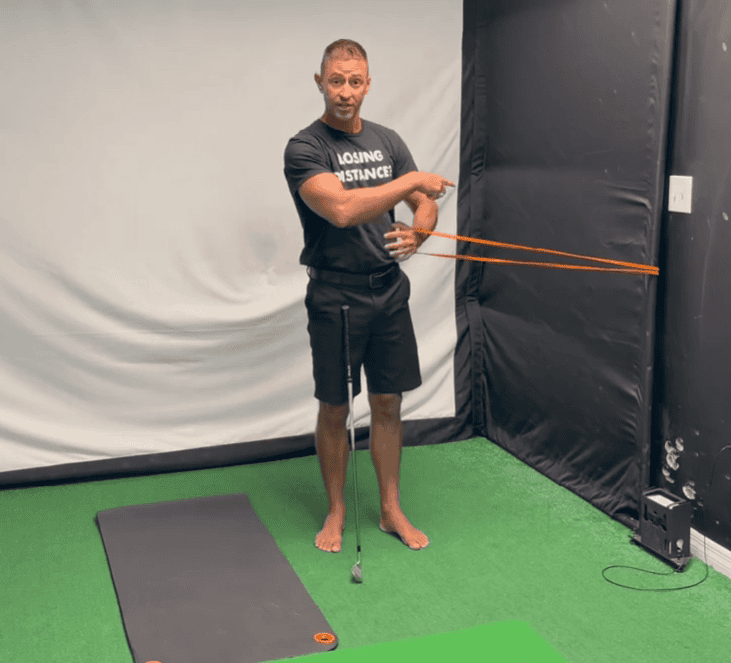
Go barefoot or as close to it as possible. This isn’t just a preference — it’s the reason the drill works. The muscles in the arch of the foot are directly connected to the activation chain that leads to the glutes. When the foot can feel the ground, those muscles contribute. When they’re buried in thick-soled shoes, they go quiet. And when the foot goes quiet, the glutes are much harder to recruit.
Now you’re ready. The yoga mat is your feedback tool. The band is your arc trainer. When both are working together, the whole kinetic chain fires — and you’ll feel exactly why real distance has been missing.
Tip #1: Activate the Ground Before You Move Anything
Here’s the most important principle in this entire drill — and the one most golfers skip completely.
Power in the golf swing doesn’t start with the hands. It doesn’t start with the shoulders. It starts with the ground.
Before the backswing begins, get into your normal address position and start pushing your right foot through the yoga mat — not just standing on it, but actively pressing through it, as if you’re trying to feel the hard floor underneath the mat.
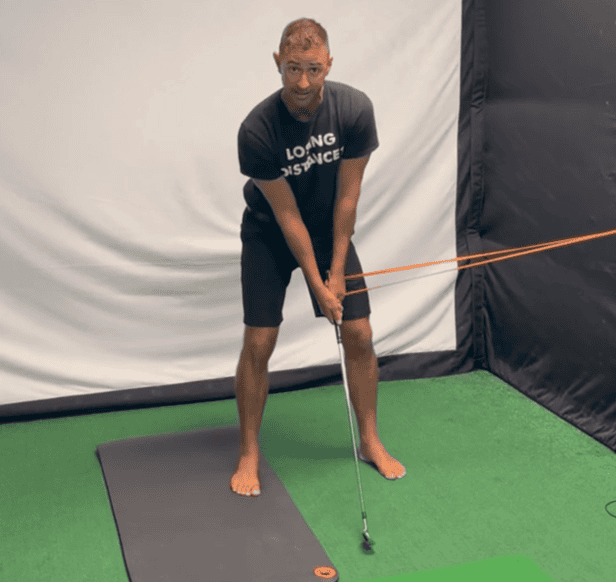
That foot pressure is what starts the chain. The moment you push through the arch, the glutes and core get the signal to engage. Pull the belly button into the spine at the same time. Now both are working — before a single backswing movement has happened.
If you don’t feel the leg working immediately, check three things. Core isn’t pulled in. Trail knee has straightened. Or the foot pressure is on the heel or the toe instead of the arch. Correct those three and the glute fires instantly.
This is why we do it barefoot. You need to feel your foot working so the brain knows the ground connection is real.
Tip #2: Initiate the Backswing With the Belt Buckle, Not the Hands
Here’s the second principle — and the one that determines whether the downswing can ever work correctly.
Whatever moves first in the backswing, the brain registers as the primary mover. If the hands go first, the brain establishes the hands as the engine. From that point forward, no matter how much you want the hips and core to drive the downswing, the hands are already in charge. The sequence is broken before it even starts.
So we don’t initiate with the hands. We initiate with the belt buckle.
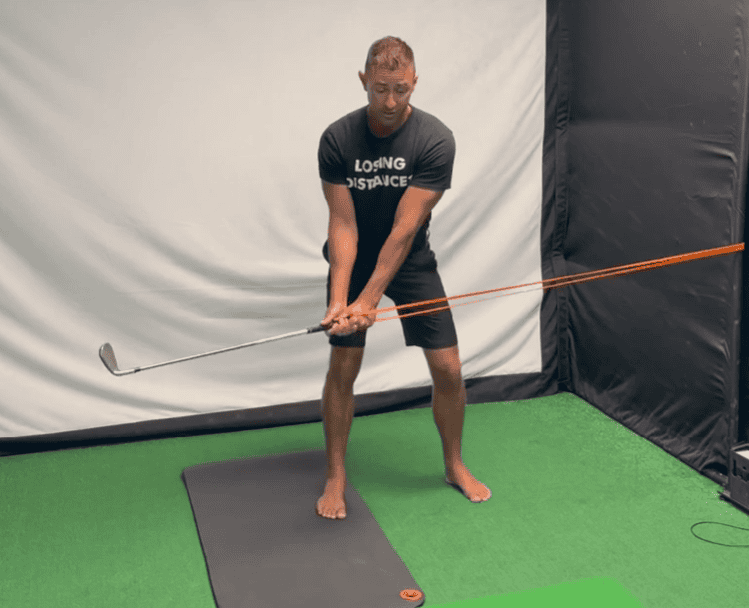
The belt buckle turns first. Hands follow the belt buckle. Shoulders finish the turn on top of the hip rotation. In that order. Every time.
Not arms reaching for parallel. Not wrapping the club around the head. The hips lead, the hands follow, and the shoulders finish.
At the top, keep the trail elbow straight — not bent, straight. And keep pressing through the mat even harder. Really try to feel the hard ground beneath the yoga mat. The whole leg should be working now. Quads. Glutes. Core. All of it firing simultaneously.
Tip #3: Stretch the Band to Maintain Extension and Arc
Here’s where the drill becomes something most golfers have never experienced.
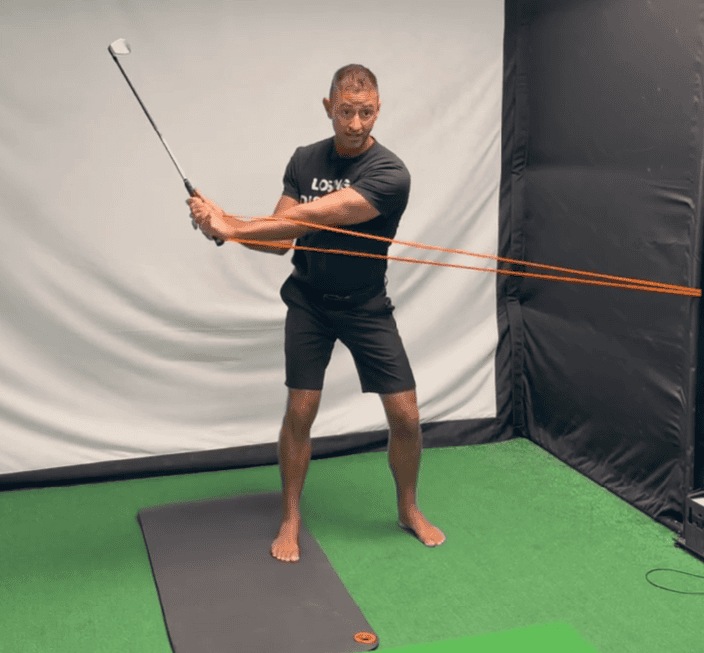
At the top of the backswing — while pressing hard through the mat and keeping the core tight — try to stretch the band. Fight against it. Extend the hands as far away from the chest as possible.
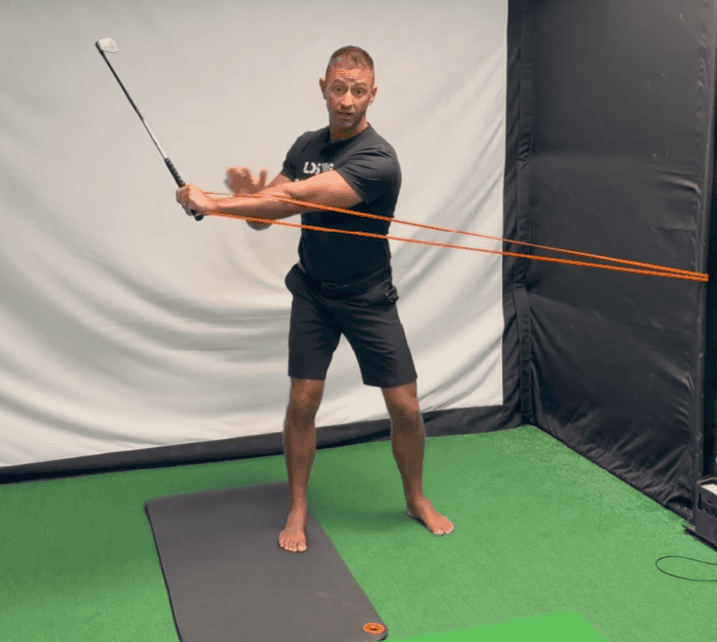
What happens when you stretch the band is exactly what’s supposed to happen in a powerful golf swing. The hands stay extended away from the body. The arc stays wide. The radius of the swing stays as large as possible.
Here’s why that matters. Clubhead speed is directly tied to arc size. A bigger arc means a faster clubhead at the bottom of the swing. A faster clubhead means more distance. This isn’t a theory or a hypothesis from some false golf prophet scrolling YouTube — it’s a law of physics. You cannot change it.
The band prevents the single most common power leak in the golf swing: wrapping the club back around the neck and collapsing the arc. The moment the hands start drifting back toward the chest, the band fights back instantly. That feedback is what makes the drill work faster than almost anything else.
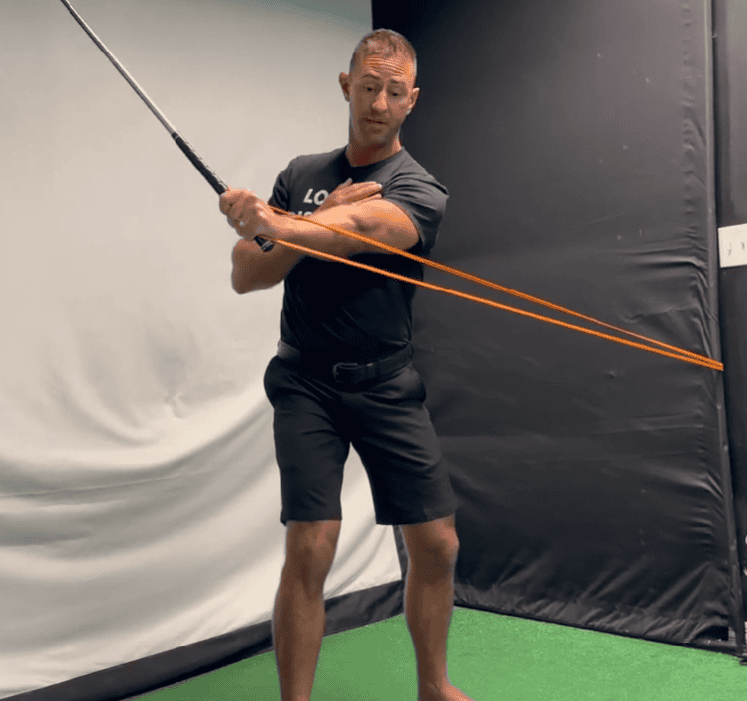
When the hands stay extended and the foot is pressing and the core is engaged, the lead elbow moves away from the body naturally. That’s not the finished product and that’s okay — it’s the drill working exactly as intended.
The Full Sequence With All Three Tips Together
Here’s what it looks like when everything connects.
Address position. Right foot on yoga mat. Left foot on hard floor. Band in normal grip. Core engaged, belly button pulled into the spine.
Push actively through the right foot — feel the hard ground beneath the mat. Glutes and quads switch on immediately.
Initiate the backswing with the belt buckle. Watch the hips turn first. Hands follow the belt buckle. Straight trail elbow. Shoulders finish the turn on top. Hold.
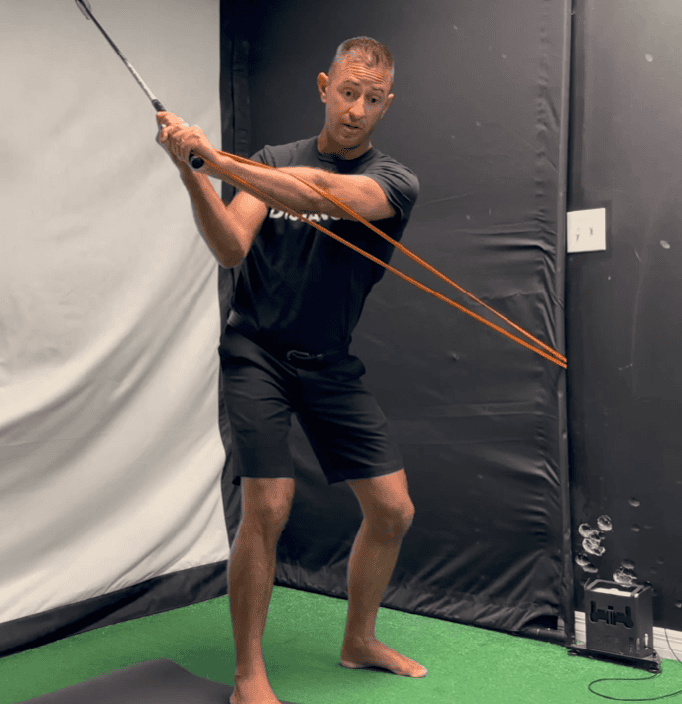
Now stretch the band. Fight against the resistance. Keep pressing harder through the mat. Hold for three full seconds. Feel every muscle working — foot, quads, glutes, core, lead arm.
Return to address. That’s one rep.
Ten reps. Three-second holds each. Rest. Repeat. Three sets total.
The three-second hold is what builds the mind-body connection. The brain needs time in the correct position to learn what it’s actually supposed to feel like. One-second touches don’t build the same motor pathway. Hold it, feel it, let the muscles fire hard, and then return to address.
Why Consistent Repetition Matters Before the Club
Here’s the trap most golfers fall into with drills like this.
They feel the glutes fire a couple of times, decide they’ve got it, pick up the driver, and immediately revert to everything they were doing before. Because the ball is on the ground and the brain goes back to chasing the result instead of the pattern.
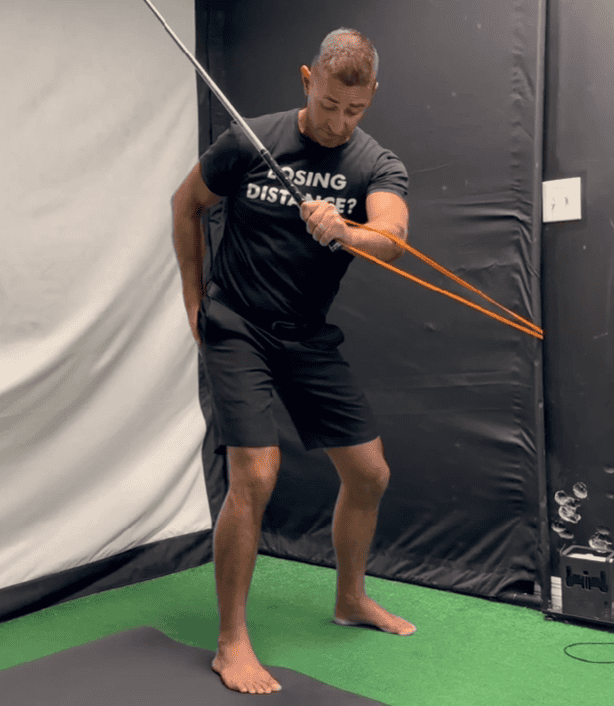
Do the drill until you can feel the glutes and core firing on every single rep — cleanly and consistently — before you introduce a real club. When you do bring in the club, start with slow-motion swings. Build the pattern first. Then add speed.
The drilling without a ball is where the motor pathway gets built. The range is where you test whether it held. In that order. Always.
And if the band is too much resistance to start, back off. Take some slack out of it. Start where you can do it 100% correctly — every rep, every time — and build the resistance gradually from there.
Get a Free Swing Analysis
Want to know exactly what your swing is doing right now — before you try to fix it?
Set your camera or phone up at two angles. One from the front, face-on. One from behind, down the line. Film in slow motion. Swing.
Send both videos to gaindistance.com and Dr. Berman will give you a free swing analysis. The first one is on him.
See exactly what the camera shows — not what the brain thinks is happening. Then you know precisely what to work on with the resistance band drill.
Want a Step-by-Step Blueprint?
If this resonates with you and you’re tired of advice designed for 25-year-old tour pros, I put together a simple blueprint specifically for senior golfers.
It breaks down:
- How the aging body changes
- Which muscles actually produce power
- How to gain distance without swinging harder
- How to improve consistency while reducing aches and pains
It’s written at a fifth-grade reading level with clear visuals and practical drills you can start immediately.
You can download a FREE digital copy at: 👉 gaindistance.com
No gimmicks. Just clarity on how your body should move so you can play better golf for years to come.
Bringing It All Together
One resistance band. Three tips. One drill that immediately tells you whether your ground connection is real, whether the belt buckle is leading the backswing, and whether the arc is staying wide enough to generate real clubhead speed.
Foot presses through the mat, glutes and core switch on. Belt buckle initiates the backswing — hands follow, shoulders finish. Band stretches at the top — arc stays wide, extension stays full. Three-second hold. Feel every muscle firing. Return to address.
Three sets of ten reps. Then pick up a club. Then hit a ball.
At Berman Golf, we focus on biomechanics first. We don’t teach cookie-cutter swings. We teach you how your body should move, especially as it ages so you can generate power safely and repeat it under pressure.
Our in-house and online coaching programs are built specifically for senior golfers who want more distance and better consistency without beating up their bodies.
If you’re tired of advice designed for tour pros and ready for a blueprint built for your body, we’re here to help.
Because when the glutes fire, the core is locked in, the arc stays wide, and the belt buckle leads the downswing, the hands get in front of the clubhead and actually compress the ball.
And when you compress the ball the right way, the game gets soooooo much easier!

Dr. Jake Berman